6 Reasons Your First Rep Always Feels Heavier Than Your Fifth
Quick Answer: The first rep of a set often feels heavier than the third or fourth because of a phenomenon involving nervous system activation, muscle temperature, and psychological readiness that all improve slightly once you’re already moving — it’s a real, well-documented effect, not just perception.
Lifters notice this constantly but rarely get a straight explanation for why rep one is the hard one and rep four suddenly feels smooth.

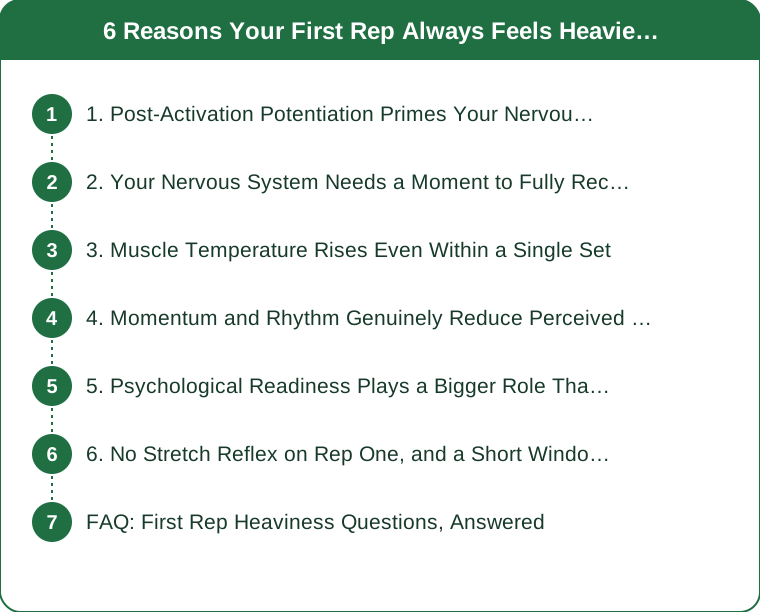
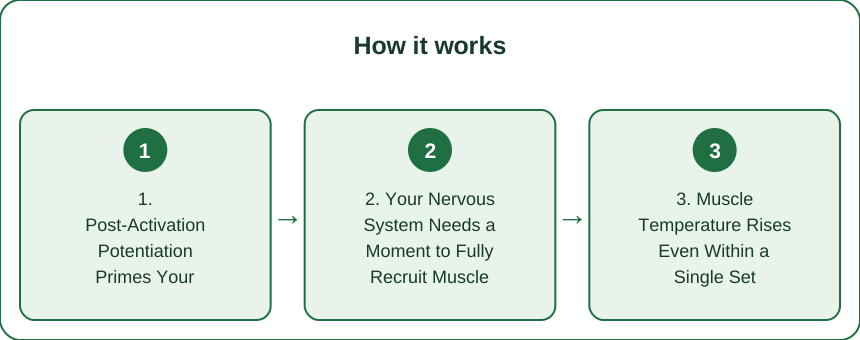
1. Post-Activation Potentiation Primes Your Nervous System
Post-activation potentiation is a real physiological effect where a muscle contraction increases the force output of subsequent contractions for a short window, meaning your first rep partially ‘primes’ your nervous system for the reps that follow. This is one of the most well-documented reasons rep two through four can genuinely feel more efficient than the first.
2. Your Nervous System Needs a Moment to Fully Recruit Muscle Fibers
Maximal or near-maximal effort requires your nervous system to recruit a large number of motor units (nerve-muscle fiber groups) almost instantly, and this recruitment isn’t always perfectly synced on the very first attempt of a set. By the second or third rep, recruitment patterns are more fully engaged, which can make the same weight feel more manageable.
3. Muscle Temperature Rises Even Within a Single Set
Muscle temperature increases slightly with each contraction, and warmer muscle tissue contracts more efficiently than cooler tissue, contributing a small but real efficiency gain across just a handful of reps. This effect stacks with the general warm-up you did before the set, meaning the working set itself continues warming the muscle further.

4. Momentum and Rhythm Genuinely Reduce Perceived Effort
Once you establish the bar path, breathing rhythm, and bracing pattern on rep one, subsequent reps benefit from that established rhythm rather than having to build it from a static, dead start each time. This is part of why a paused first rep from a complete stop often feels notably harder than a continuous rep that follows immediately after another.
5. Psychological Readiness Plays a Bigger Role Than Lifters Expect
The mental buildup before a heavy first rep — hesitation, anticipation, bracing for maximal effort — can create tension that works against smooth force production, an effect that fades once you’re already mid-set and the anticipation has passed. This is one reason experienced lifters often cue themselves to ‘just start’ rather than over-preparing mentally for the first rep specifically.
6. No Stretch Reflex on Rep One, and a Short Window Before Real Fatigue Takes Over
Many exercises benefit from the stretch-shortening cycle — a natural elastic energy return when a muscle is stretched right before contracting — which isn’t available on a true first rep starting from a static dead position the way it is on reps that flow directly from the previous one’s descent. Early reps in a set also sit in a brief window where potentiation and rhythm benefits outweigh the beginning of fatigue, which is why rep 3-4 can feel like the ‘sweet spot’ — past the awkward first rep, but before real fatigue sets in toward the end.
FAQ: First Rep Heaviness Questions, Answered
Does this mean warm-up sets aren’t necessary if the first working rep is going to feel hard anyway?
No — warm-up sets still matter for injury prevention and motor pattern rehearsal; this effect is about within-set variation, not a replacement for a proper warm-up.
Is it normal for the first rep specifically to feel unstable or shaky?
Some instability on a true first rep from a dead stop is common and usually resolves by rep two once rhythm and bracing are established.
Can you train to reduce how much harder the first rep feels?
Some lifters use an unloaded or lightly loaded ‘primer rep’ immediately before the working set specifically to reduce this effect, though it’s a minor optimization rather than a necessity.
TL;DR:
- Post-activation potentiation genuinely makes early reps after the first feel more efficient
- Nervous system recruitment and rising muscle temperature both improve slightly within a set
- Established rhythm and bar path reduce effort on reps after the first
- Psychological anticipation before rep one adds real, measurable tension that fades afterward
The heavy-feeling first rep isn’t in your head — it’s a documented mix of physiology and psychology, and it resolves itself within a couple of reps almost every time.
Keep Reading
This article is for general informational and styling purposes only. Fit, sizing, and product availability may vary.