Why Your Warmup Sets Feel Heavier Than Your Working Sets
Quick Answer: Early sets feel heavy because your nervous system has not yet recruited efficiently, your tissue is cool, and you have no recent reference for what heavy feels like. As you ramp, motor unit recruitment improves, muscle temperature rises, and a phenomenon called post-activation potentiation makes subsequent efforts feel lighter. So the bar genuinely does move better later, and it means an empty-bar-to-top-set ramp is a performance tool, not a formality.
If your first working set is your worst set, your warmup ended too early.

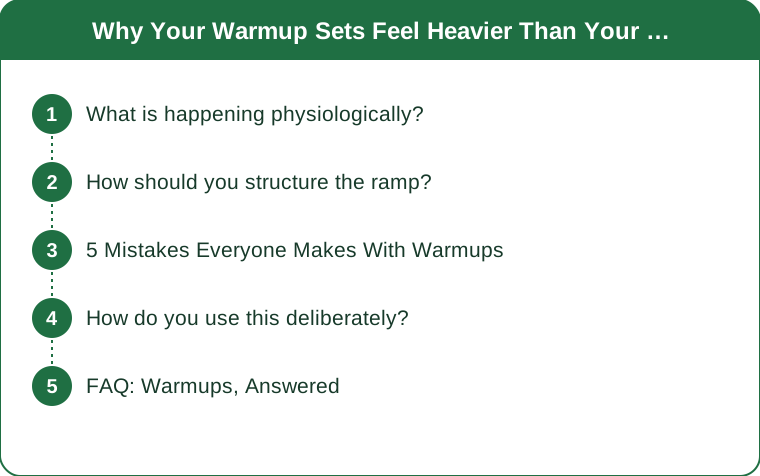
What is happening physiologically?
Three overlapping things.
Motor unit recruitment improves with use. At the start of a session, your nervous system is not yet recruiting high-threshold motor units efficiently or synchronously. Ramping sets progressively demand more recruitment, and the system responds. By your third or fourth ramp set, you have access to force production you literally did not have on the first one.
Muscle temperature rises, and warm tissue performs better. Enzyme activity, nerve conduction velocity and muscle compliance all improve with temperature. Force production and rate of force development both rise measurably. A muscle at 38 degrees performs meaningfully better than the same muscle at 35.
Post-activation potentiation, which is the interesting one. Heavy or intense muscle contraction temporarily increases the force output of subsequent contractions, through mechanisms including phosphorylation of myosin regulatory light chains and increased motor unit recruitment. The effect is real, well-documented, and time-dependent: it peaks somewhere in the range of a few minutes after the potentiating effort and decays after that.
Then there is the perceptual side, which is not trivial. Weight is judged relative to recent experience. Sixty kilos immediately after an empty bar feels enormous. The same sixty kilos immediately after eighty feels like nothing. Your sense of heaviness is calibrated by what you just lifted, which is why the last warmup set often feels easier than the first.
How should you structure the ramp?
Start lighter and take more steps than feels efficient. A ramp of five or six sets to a heavy single or triple gives the nervous system more opportunity to potentiate than two big jumps. The sets are cheap because the loads are light.
Keep the reps low as the weight climbs. Warmup sets are for preparation, not fatigue. Five reps at 40 percent, three at 60, two at 75, one at 85, then the working set. Doing eight reps at 70 percent costs you the top set.
Mind the rest between the last warmup and the first working set. Too short and you carry fatigue; too long and the potentiation and the temperature both decay. Roughly two to three minutes is a reasonable default, and it is worth experimenting because the optimum varies considerably between people.
Do a general warmup before the specific one. Five to ten minutes of easy full-body movement raises muscle temperature systemically, which the barbell ramp alone does not do efficiently. This matters more as the weather cools.
Add a heavier-than-working single if you respond to it. Some lifters use a load above their working weight, for a partial or a single, then drop back. The working set then feels notably lighter. This works well for some people and adds unnecessary fatigue for others, so test it rather than adopting it.
And re-warm after long gaps. If you sit for fifteen minutes between exercises, or if the gym is cold, the temperature effect has gone. A quick set at a light load restores it.

5 Mistakes Everyone Makes With Warmups
Mistake 1: Jumping straight to something close to working weight. Two sets from empty bar to 80 percent skips the recruitment ramp entirely, and the first working set becomes the real warmup, which means the whole session runs one set behind.
Mistake 2: Doing too many reps in warmup sets. High-rep warmup sets create fatigue without adding preparation. Warmups should never approach failure.
Mistake 3: Static stretching before lifting. Prolonged static stretching before heavy work has been shown to acutely reduce force production. Save it for after, and use dynamic movement before.
Mistake 4: Warming up only the target muscle. Heavy compound lifts load the whole system, and a general warmup raises core and muscle temperature far more effectively than a few sets of the lift alone. In a cold gym this is the difference-maker.
Mistake 5: Using the same warmup regardless of the session or the weather. A 10 degree morning in October and a 24 degree evening in July need different preparation times, and almost everyone runs the same routine year-round. This is the mistake that quietly costs the most performance in autumn and winter.
How do you use this deliberately?
Treat the last warmup set as a diagnostic. How the 85 percent single moves tells you a lot about what the working sets will do that day. If it grinds, adjusting the session down is better information-led training than pushing on.
Use it to plan the top set. Many experienced lifters autoregulate by feel from the ramp, choosing the working load based on how the ramp moved rather than what the programme said. That is a legitimate and well-supported approach.
Sequence exercises to exploit warmth. Do the heaviest, most technical lift first when you have ramped for it, and put accessory work later when the system is warm and the technical demand is lower.
Shorten the ramp for later exercises. Once you have squatted, you do not need a full ramp for leg press. The general warmth and recruitment carry over; only the movement specificity needs establishing.
Increase warmup length as temperature drops. In a cold gym, budget an extra five minutes. It will feel like wasted time and it will not be.
Notice the perceptual trick and use it. If a load feels intimidating, handling something heavier for a partial or a hold beforehand recalibrates your sense of it. This is a real, usable effect.
And distinguish heavy from wrong. A set that feels heavy but moves smoothly is normal. Pain, a sudden loss of position, or a joint that feels unstable is different and means stopping. This is general information, not medical advice.
FAQ: Warmups, Answered
How many warmup sets should I do?
For a heavy compound lift, typically four to six ramping sets. Fewer for lighter accessory work.
Should warmup sets ever be hard?
No. They should feel progressively more substantial and never approach failure.
How long should I rest before the first working set?
Commonly two to three minutes. Long enough to recover, short enough that warmth and potentiation remain.
Does cardio count as a warmup for lifting?
As a general warmup, yes, five to ten minutes is useful for raising temperature. It does not replace the specific ramp in the lift itself.
Is static stretching bad before lifting?
Prolonged static stretching acutely reduces force output. Short holds are unlikely to matter much; dynamic movement is the better default.
Why does the same weight feel different on different days?
Sleep, food, stress, prior training and temperature all shift it. Autoregulating from how the ramp moves is more useful than forcing the programmed number.
TL;DR:
- Early sets feel heavy because recruitment, tissue temperature and perceptual calibration are all still low.
- Post-activation potentiation genuinely makes later efforts feel lighter, and it decays over minutes.
- Ramp in more, smaller steps with low reps; warmups should never fatigue you.
- Do a general warmup first, and lengthen it as the gym gets colder.
- Use the last warmup set as a diagnostic for what to do on the top set.
- Skip prolonged static stretching before heavy work.
If your first working set is always your worst, add two more ramp sets and the problem disappears.
Keep Reading
This article is for general informational and styling purposes only. Fit, sizing, and product availability may vary.