6 Signs Your Program Is Too Hard to Actually Progress On
Quick Answer: A program is too hard if you are missing planned reps more than about 20 percent of the time, dreading sessions, seeing performance drop across weeks rather than within them, sleeping worse, getting persistently sorer, or needing stimulants to train. Difficulty that produces progress shows up as fatigue within a session; difficulty that does not shows up as decline across weeks.
There is a version of hard that builds you and a version that just buries you, and they feel nearly identical in the moment.
Both leave you exhausted. Both feel like effort. Only one produces a bigger squat in eight weeks.
Here are the six markers that reliably tell them apart, and the fourth one is the one lifters rationalize hardest.

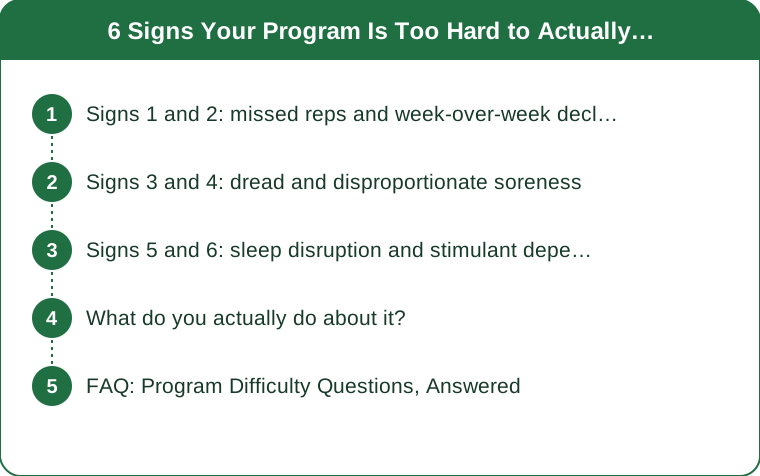
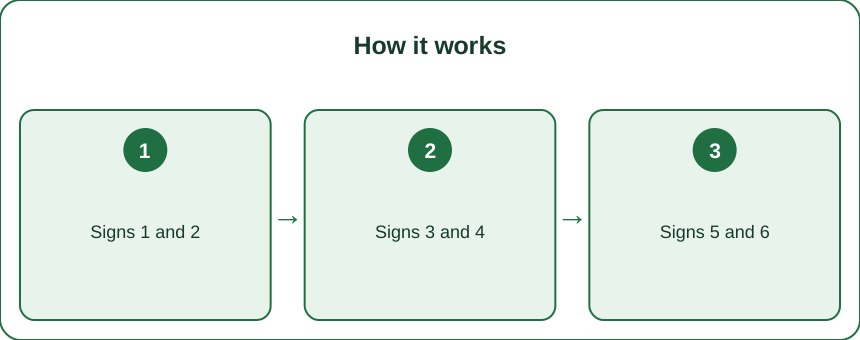
Signs 1 and 2: missed reps and week-over-week decline
1. You are missing planned reps more than one session in five
A good program should have you completing the prescribed work most of the time, with occasional grinders. If you write down 4 sets of 8 and regularly get 8, 7, 6, 5, the load is not appropriate for the volume — you are training to failure by accident every session.
Failure is a tool, not a default setting. Occasional proximity to failure on the last set drives adaptation. Reaching it on every set drives fatigue that outlasts the stimulus.
Track it for two weeks. If your completion rate is under 80 percent, cut load by roughly 10 percent and see how the next block feels.
2. Performance is declining across weeks, not within sessions
Getting weaker as a session goes on is normal and expected. Getting weaker week over week is the clearest signal in this entire list.
If week three of a block is worse than week one on the same lifts at the same loads, you are accumulating more fatigue than you are dissipating. That is not toughness. That is a program that has outrun your recovery capacity.
Deload — one week at roughly 50 to 60 percent of normal volume — and watch the numbers come back up, often above where they were.
Signs 3 and 4: dread and disproportionate soreness
3. You are dreading sessions, not just not looking forward to them
Neutral is fine. Mild reluctance on a cold morning is fine. Genuine dread — checking the clock, hoping something comes up — is a legitimate physiological signal, not a character flaw.
Persistent aversion to training tracks with accumulated fatigue and elevated stress load remarkably well. Your motivation system has information your logbook does not.
4. Soreness that never fully clears
This is the one people wear as a badge. But soreness that is still present when you train the same muscle again, week after week, means the tissue has not completed recovery, and training damaged tissue produces more damage rather than more adaptation.
Normal: sore for 24 to 48 hours after a hard session, especially after new movements.
A problem: baseline soreness that never returns to zero, or soreness that keeps increasing across a block at constant volume.
Chasing soreness is the most common way lifters accidentally train fatigue instead of strength.

Signs 5 and 6: sleep disruption and stimulant dependence
5. Sleep is getting worse, not better
Appropriate training generally improves sleep. Excessive training degrades it — trouble falling asleep despite exhaustion, waking at 3 or 4am, an elevated resting heart rate in the morning.
If you have a wearable, a resting heart rate elevated by 5 or more beats per minute over your baseline for several consecutive days is a reasonable flag, though treat any single metric with appropriate skepticism.
6. You cannot train without stimulants
Needing 300mg of caffeine to face a session you used to do on coffee is worth noticing. Pre-workout can mask fatigue, which is precisely the problem — masking the signal does not remove the underlying state.
Try one week of training with no stimulants. If your sessions are unrecognizable without them, they were being propped up rather than performed.
What do you actually do about it?
Not quit, and not push harder. Three options, in order of how often they are the right answer:
Deload for one week. Keep the movements, cut volume by 40 to 50 percent, keep intensity moderate. Most people return stronger within one week. This resolves the majority of these situations.
Cut volume permanently, not intensity. If deloads keep being necessary, the baseline volume is too high for your current recovery. Removing one or two sets per exercise usually costs nothing in progress and buys back recovery.
Look outside the gym. Sleep, calories, and life stress determine recovery capacity more than program design does. A program that worked in a calm month can be too much in a chaotic one — and the program is not the thing that changed.
The uncomfortable truth: the correct amount of training is the most you can recover from, not the most you can perform. Those are very different numbers.
FAQ: Program Difficulty Questions, Answered
How do I know if I need a deload or just a bad week?
One bad session is noise. Two consecutive weeks of decline on the same lifts is a signal. Deloads are cheap — a week costs almost nothing and often gains more than it costs.
Is it possible to train too little?
Yes, and it is more common than people think for intermediates. If you are recovering fully, never sore, and not progressing, add volume before you add intensity.
Should soreness be the goal at all?
No. Soreness correlates poorly with growth. Progressive overload and consistency correlate strongly. Use your logbook as the scoreboard, not your Tuesday hamstrings.
TL;DR:
- Missing more than 20 percent of prescribed reps means the load is too high for the volume
- Week-over-week decline is the clearest signal of accumulated fatigue
- Persistent soreness, worsening sleep, dread, and stimulant dependence are all real markers
- Deload a week, then cut volume rather than intensity if it recurs
Look at your last three weeks of logged sets. If the same weight moved worse each week, you have your answer, and it is a good week off rather than a harder Monday.
Keep Reading
This article is for general informational and styling purposes only. Fit, sizing, and product availability may vary.