6 Signs Your Program Needs a Deload, Not More Motivation
Quick Answer: Deload when warm-up weights feel heavy, when your usual sets take more effort at the same load, when motivation drops specifically for training you normally enjoy, when sleep or resting heart rate shifts, when small joints start complaining, or when performance has been flat for two to three weeks despite consistent effort. Accumulated fatigue and low motivation feel identical from the inside, and the markers are how you tell them apart.
The bar feels heavier than it should. You do not want to be here. Everything is a bit harder than last month.
The internal explanation is usually some version of I have gotten soft, and the response is usually to push harder.
That is often exactly backwards, and there are specific signals that tell you which situation you are in.

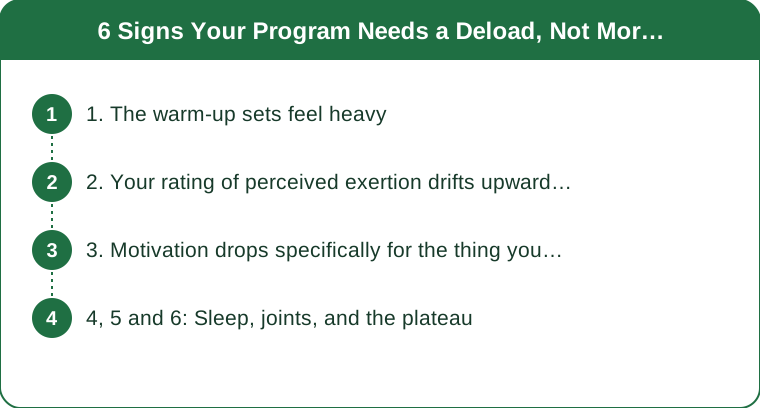
1. The warm-up sets feel heavy
The single most reliable early marker, and the one experienced lifters watch first.
Your warm-up weights are fixed percentages you have handled hundreds of times. They should feel light every session. When 60% of your working weight starts feeling like real work, something has changed systemically — because that load has not.
This matters because the warm-up happens before any fatigue from the session itself, so it is a clean reading of your current state.
What to watch for specifically: bar speed on the second warm-up set. Not how it feels, which is subjective — how fast it moves. Experienced lifters and velocity-based training systems both rely on this because bar speed at submaximal loads drops measurably before maximal strength does.
If two or three sessions in a row have heavy-feeling warm-ups, that is a signal rather than a bad day.
2. Your rating of perceived exertion drifts upward at the same weight
Same load, same reps, more effort.
If a set of five at a given weight was an 8 out of 10 three weeks ago and is a 9.5 now, you have not lost strength in three weeks — you have accumulated fatigue. Strength is not lost that quickly. Fatigue is gained that quickly.
This is why logging RPE alongside weight and reps is worth the small effort. Weight and reps alone hide the trend completely, because the numbers on the page look identical while the cost of producing them has risen.
A useful threshold: a sustained one-point RPE drift at the same load, across two weeks, warrants a deload. Not a single bad session — a trend.

3. Motivation drops specifically for the thing you like
General life motivation and training motivation are different signals, and the distinction is diagnostic.
Not wanting to train when you never want to train is not information. Not wanting to train when you normally look forward to it is.
This is a recognized feature of functional overreaching. Mood disturbance often precedes measurable performance decline, and it is one of the earlier indicators in the research on training stress.
The specific version to watch for: dreading the sessions you normally enjoy most. A lifter who loves squatting and starts finding reasons to move squat day is giving a clear signal, and it is one that gets misread as a discipline problem more than almost anything else on this list.
4, 5 and 6: Sleep, joints, and the plateau
4. Sleep changes, in either direction. Accumulated training stress commonly disrupts sleep — difficulty falling asleep despite physical tiredness, waking in the early hours, or needing dramatically more sleep than usual. Elevated resting heart rate on waking, sustained over several days, is a related marker and one that any wearable will show you. A rise of 5 or more beats above your baseline is worth attention.
5. Small joints start complaining. Not injury — the low-grade aching in elbows, wrists, knees, and the front of the shoulder that appears when connective tissue is accumulating load faster than it recovers. Connective tissue adapts more slowly than muscle does, which is exactly why it becomes the limiting factor during long hard blocks. Tendons and ligaments have poorer blood supply and slower turnover, so they are the tissue that tells you the block has gone on too long.
6. Performance has been flat for two to three weeks. Not declining — flat. A plateau despite consistent, progressive effort is the classic picture of fatigue masking fitness. The fitness is there; the fatigue is hiding it, and a deload is what reveals it. This is why lifters so often hit personal records in the week after a deload rather than during a hard block.
5 Things a Deload Is Not
- It is not a week off. Complete rest is usually worse than reduced training for maintaining the pattern and the habit.
- It is not losing your progress. Detraining in trained lifters takes considerably longer than a week; there is no meaningful strength loss in seven days.
- It is not for beginners only, or advanced lifters only. Everyone accumulates fatigue; more advanced lifters accumulate it faster because they can generate more stress.
- It is not a reward you earn. It is a scheduled part of programming. Most well-designed programs deload every 4 to 8 weeks by default, before the signals appear.
- It is not one prescription. The common approach is keeping intensity and cutting volume — roughly 50% of your usual sets at 85 to 90% of your usual load — which sheds fatigue while maintaining the movement pattern and the neural adaptation.
This is general fitness information, not medical advice. Persistent fatigue that does not resolve with reduced training deserves a conversation with a doctor, since several medical conditions present this way.
TL;DR:
- Heavy-feeling warm-up sets are the earliest clean signal, because that load has not changed.
- Log RPE — a sustained one-point drift at the same weight over two weeks means fatigue, not lost strength.
- Dreading the sessions you normally enjoy is a mood marker that typically precedes performance decline.
- Watch sleep disruption, resting heart rate 5+ beats above baseline, aching small joints, and a two-to-three week plateau.
- Deload by cutting volume to about half while keeping intensity near 85 to 90% — and schedule it every 4 to 8 weeks rather than waiting for symptoms.
Keep Reading
This article is for general informational and styling purposes only. Fit, sizing, and product availability may vary.