7 Reasons Your Warm-Up Sets Feel Worse Than Your Working Sets
Quick Answer: Light early sets often feel worse because your nervous system has not yet ramped up, muscle temperature is low, connective tissue is stiffer, and you have not calibrated your force output to the load. Post-activation potentiation means each set primes the next, so set three genuinely is easier than set one relative to its weight. Fix it with a longer general warm-up, more warm-up sets with smaller jumps, and one or two heavier singles before your working weight.
Everybody has had the session where 40kg felt terrible and 80kg felt fine.
It is a common enough experience that lifters joke about skipping to the working weight. There are seven distinct reasons behind it, and most of them point to warming up differently rather than less.

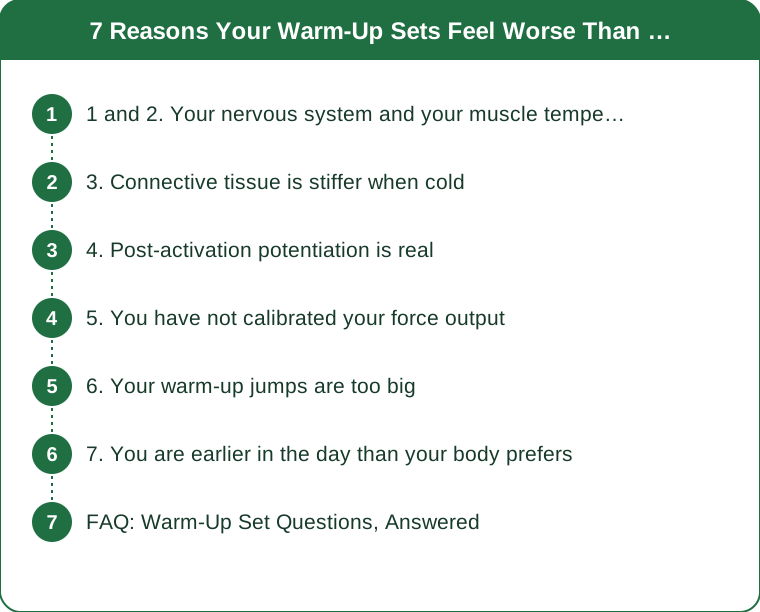
1 and 2. Your nervous system and your muscle temperature are both still low
1. Your nervous system has not ramped up
Motor unit recruitment is not instantaneous. Early in a session, your ability to recruit high-threshold motor units and to fire them at high rates is well below your daily peak.
So your first set is performed with a fraction of your available force production capacity. The weight is light, and so is the force you can produce, and the ratio between them is worse than it will be twenty minutes later.
The signature of this: the bar feels heavy in a vague, uncoordinated way rather than a straining way. You are not near failure and it does not feel smooth.
2. Muscle temperature changes contractile performance
Warmer muscle contracts faster and produces more force. The commonly cited figure is a few percent of force output per degree of muscle temperature, and muscle temperature takes 10 to 20 minutes of activity to rise meaningfully.
Which means your first set is performed by cold muscle, and cold muscle is measurably weaker and slower than the same muscle at working temperature.
The practical consequence: general warm-up before you touch a bar is not optional filler. Five to ten minutes of easy cardio or dynamic movement changes the quality of your first set more than an extra warm-up set does.
3. Connective tissue is stiffer when cold
Tendons and fascia are viscoelastic, meaning their behaviour depends on temperature and on recent loading. Cold, they are stiffer and less compliant.
That changes the feel of a movement substantially. A squat with cold hips and ankles has less available range and more resistance to moving into position, which reads as heavy even though the load is light.
Where you notice it most: the bottom of a squat, the lockout of a bench press, and the first few reps of any overhead work. All positions where tissue compliance matters.
This is also why the first rep of a set is often the worst one. The tissue has not been loaded through that range yet in the session.
4. Post-activation potentiation is real
Contracting a muscle enhances its subsequent performance for a window afterwards. The mechanisms include phosphorylation of myosin light chains and increased motor unit recruitment.
In practice: each set makes the next set better, up to the point where fatigue takes over. Your second warm-up set benefits from the first, your third from the second, and your working set benefits from all of them.
Which is why the working set feels smooth. It is being performed by a system that has been primed three or four times, whereas set one was performed cold with no priming at all.
Exploiting it deliberately: a single heavier than your working weight, at around 100 to 105 percent of it, performed for one rep before your working sets, often makes the working weight feel notably lighter. This is a known technique and it works better for experienced lifters than for beginners.

5. You have not calibrated your force output
Your brain estimates how much force a lift requires and delivers roughly that amount. Early in a session that estimate is poorly tuned, so you either under-deliver, which makes the bar feel sluggish, or over-deliver, which makes it feel jerky and uncontrolled.
The common version: you brace and pull hard for a warm-up set as though it were heavy, the bar shoots up awkwardly, and it feels wrong. Or you treat it casually, produce too little force, and it feels heavy.
How to reduce it: treat warm-up sets as technique rehearsal with deliberate intent, matching your bar speed to what you want on the working set. Same tempo, same brace, same setup, less weight. This calibrates the estimate rather than leaving it to guess.
6. Your warm-up jumps are too big
Going from an empty bar to 60 percent to your working weight gives your system three data points to calibrate on and very little priming.
A better structure, for a working weight of 100kg:
- Empty bar, 8 to 10 reps
- 40kg, 5 reps
- 55kg, 4 reps
- 70kg, 3 reps
- 82kg, 2 reps
- 92kg, 1 rep
- 100kg, working sets
That looks like a lot and it takes under ten minutes, since rest between light sets is short. The payoff is a first working set that feels like a third working set.
Adjust the count by load, not by ego. Heavier working weights need more warm-up sets, not fewer. A 60kg working weight might need three; a 140kg working weight needs six or seven.
7. You are earlier in the day than your body prefers
Strength follows a circadian rhythm, typically peaking in the late afternoon or early evening, with differences of several percent between morning and evening peaks.
Morning lifters get the worst of both. Lower body temperature, lower baseline neural drive, and stiffer tissue after a night of inactivity. The same absolute weight genuinely feels heavier at 6am than at 6pm.
What helps if morning is your only option:
- Longer general warm-up, 10 to 15 minutes rather than 5
- More warm-up sets with smaller jumps
- Accept slightly lower loads on early sessions and judge progress across weeks rather than against your evening numbers
- Caffeine, which partially offsets the morning deficit
The adaptation is real. Consistently training at the same time shifts your peak toward that time over weeks, so morning lifting gets better if you keep doing it.
Seasonal note: this problem gets worse over the next couple of months. Cooler gyms, colder commutes, and darker mornings all reduce starting muscle temperature. If your warm-up worked in July and your first set feels awful in October, add five minutes to the general warm-up before you conclude anything about your strength.
This is general information, not medical advice. Sharp pain during warm-up sets is different from heaviness and is worth investigating rather than warming through.
FAQ: Warm-Up Set Questions, Answered
Why does the empty bar feel heavy at the start?
Cold muscle produces less force, connective tissue is stiffer, and your nervous system has not ramped up recruitment. The load is light but so is your available output, so the ratio is worse than it will be later.
How many warm-up sets should I do?
Scale with the working weight. Around three for a light working set, six or seven for a heavy one, with jumps small enough that each set primes the next.
Is it bad to skip warm-up sets if the weight feels fine?
You lose the potentiation and calibration benefit, so your first working set is worse than it needs to be, and injury risk rises with cold tissue at heavy loads. The ten minutes buys you better sets.
TL;DR:
- Cold muscle is measurably weaker, stiffer tissue reduces available range, and neural drive starts low. All three make light sets feel heavy.
- Post-activation potentiation means each set primes the next, so your working set genuinely benefits from every warm-up set before it.
- Use smaller jumps and more warm-up sets, and match bar speed and bracing to your working set intent.
- Strength peaks in the late afternoon. Morning sessions need a longer general warm-up, not the same one done faster.
If your first set feels awful, the answer is almost always more warm-up, done better, rather than less of it.
Keep Reading
This article is for general informational and styling purposes only. Fit, sizing, and product availability may vary.