7 Reasons Your Lifts Feel Heavier the Week You Switch Gyms
Quick Answer: Bars vary in weight, whip, and knurl; plates vary by several percent; floors, racks, and machines all change the mechanics of a lift. A weight that felt routine at your old gym can genuinely be harder at the new one, and none of that is lost strength. Give it three sessions, drop 5 to 10 percent for the first week, and re-baseline rather than pushing through.
You did not lose strength over a weekend.
You changed roughly nine variables at once and only one of them - the number on the plates - is written down anywhere.

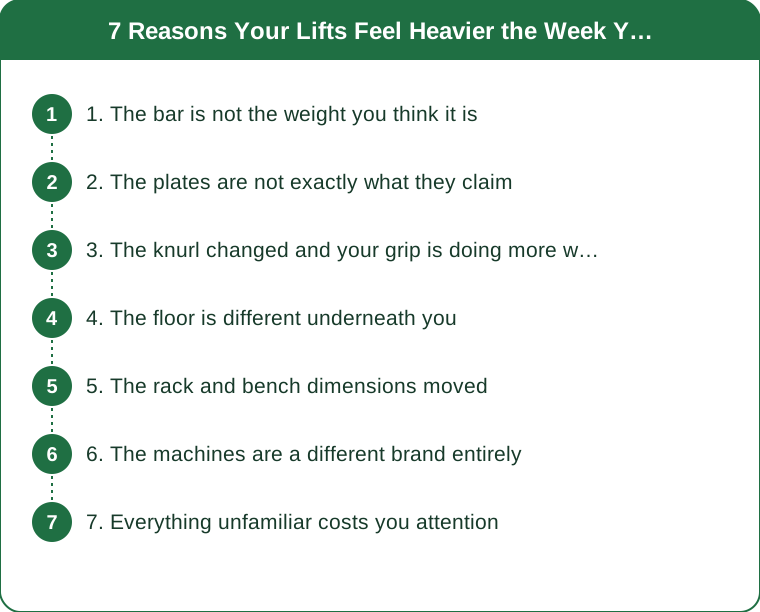
1. The bar is not the weight you think it is
Not every barbell weighs 20kg. Training bars run 15 to 20kg, some commercial bars are 18kg, and older or unmarked bars can be anywhere in that range without a label to tell you.
A 2kg difference at the bottom of every set is meaningful on lighter lifts and adds up across a session.
Whip matters as much as weight. A stiff power bar and a flexible weightlifting bar feel completely different at the same load, particularly out of the bottom of a squat or off the floor.
Diameter varies too. A 28mm bar and a 32mm bar feel different in the hand, and a thicker bar is genuinely harder to hold on pulling movements even at identical weight.
What to do: weigh the bar if you can, or ask. Most staff know, and it removes the single largest source of confusion in the first week. Then note which bar you used, because gyms often have several and they are rarely interchangeable.
2. The plates are not exactly what they claim
Plate tolerance is wider than most people assume. Cast iron plates commonly vary by 2 to 3 percent, and cheaper ones more, which means a loaded bar can differ by several kilos between two gyms at the same nominal weight.
Calibrated competition plates are within grams; standard commercial plates are not.
Bumper plates and iron plates also load differently on the bar, changing the diameter and the moment arm on deadlifts if the diameters are non-standard.
Worn plates lose material over years, so an old gym’s well-used 20kg plates may genuinely weigh less than a new gym’s fresh ones - which can make a new gym feel harder for an entirely mundane reason.
What to do: treat the first few weeks at a new gym as a re-baseline rather than a continuation. The numbers are not directly comparable and pretending they are causes more problems than it solves. Record your new working weights as a fresh set rather than trying to reconcile them with the old ones.
3. The knurl changed and your grip is doing more work
Aggressive knurling grips your hand and passive knurling does not. On a smooth bar you have to grip harder to hold the same weight, and that extra grip demand shows up as earlier forearm fatigue and a heavier-feeling bar.
On pulling movements this is the difference between a set that ends because of your back and one that ends because of your hands.
Centre knurl matters for squats. A bar with no centre knurl slides on the back more readily, which means more upper back tension to hold it in place.
What to do: use chalk if permitted, and expect the first week of pulling to be grip-limited. That resolves quickly rather than indicating a real change in strength.

4. The floor is different underneath you
Platform stiffness changes force transfer directly. A solid lifting platform returns almost everything you put into it; thick rubber matting over a sprung floor absorbs a noticeable amount, particularly on squats and pulls.
Soft flooring also reduces stability, which means more work spent on balance and less available for the lift itself.
Deadlifts are the most affected, because a bar sitting on thick matting starts at a slightly different height and the pull begins from a marginally different position.
Upper floors flex more than ground floors, and a gym on the second storey of a building genuinely returns less force than a basement one - which is a real effect rather than a superstition among lifters.
What to do: find the stiffest surface in the gym for heavy work, which is usually the platform or the area directly over a structural floor rather than the middle of a matted zone. Then use the same spot every time so the variable stops moving.
5. The rack and bench dimensions moved
Bench height varies by several centimetres between manufacturers, and that changes your leg drive position and your arch. A bench 3cm higher than you are used to alters the whole setup.
Rack pin spacing changes your unrack. If the closest hole is 2cm too high or too low, every squat begins with an unfamiliar movement before the set even starts.
J-cup depth and safety bar placement change how far you walk out and how confident you feel at the bottom, and confidence is not a small factor in a maximal effort.
What to do: spend one session setting up your positions and writing the numbers down - pin heights, bench position, hole numbers. It removes the variable permanently.
6. The machines are a different brand entirely
Machine resistance curves are brand-specific, so a leg press at one gym is not comparable to a leg press at another even at identical plate loads.
Cable stacks differ in pulley ratio, meaning a 50kg selection can deliver substantially different resistance at the handle between two manufacturers.
Seat and pad positions change the muscle emphasis more than most people expect - a chest press with a slightly different pad angle is a different exercise.
Cable heights and attachment points differ as well, so a movement you have done for years can have a slightly different line of pull, which changes both the feel and the weight you can handle.
What to do: re-establish working weights on every machine in the first fortnight rather than transferring your old numbers. Expect the differences to be large and unpredictable in both directions, and do not treat a lower number on an unfamiliar machine as evidence about your strength.
7. Everything unfamiliar costs you attention
Novelty consumes focus that used to go into the lift. Finding equipment, judging how busy a rack is, and navigating unfamiliar etiquette all draw from the same limited pool as your set does.
Arousal levels change too. A gym that is louder, quieter, busier, or colder than your old one shifts your state, and state affects maximal effort measurably.
Temperature is a genuine factor. A cooler gym means a longer warm-up requirement, and skipping that is a common cause of a heavy-feeling first few weeks.
What to do: drop 5 to 10 percent for the first week, add a few extra warm-up sets, and give it three sessions before drawing any conclusion. Almost everyone who changes gyms reports the same thing, and almost everyone is back to baseline within a fortnight.
TL;DR:
- Bars vary from 15 to 20kg and differ in whip; plate tolerance is commonly 2 to 3 percent, so loaded weights are not directly comparable between gyms.
- Knurl aggression changes grip demand, and floor stiffness changes how much force actually reaches the bar.
- Bench height, rack pin spacing, and J-cup depth all move your setup before the set begins.
- Machines are brand-specific and should be re-baselined entirely rather than carried over.
- Novelty costs attention, and a cooler gym needs a longer warm-up.
Drop 5 to 10 percent for the first week, write down your new setup numbers, and give it three sessions before concluding anything about your strength.
Keep Reading
This article is for general informational and styling purposes only. Fit, sizing, and product availability may vary.