7 Signs Your Lifting Program Needs to Change Before You Get Frustrated and Quit
Quick Answer: If your lifts haven’t moved in 4-6 weeks despite consistent effort, or your workouts feel neither challenging nor enjoyable, your program is signaling it’s time for a change — usually in volume, exercise variety, or intensity, not necessarily a full overhaul.
Progress rarely stops all at once. It fades out through small warning signs, and most people miss every one of them until the plateau is undeniable.

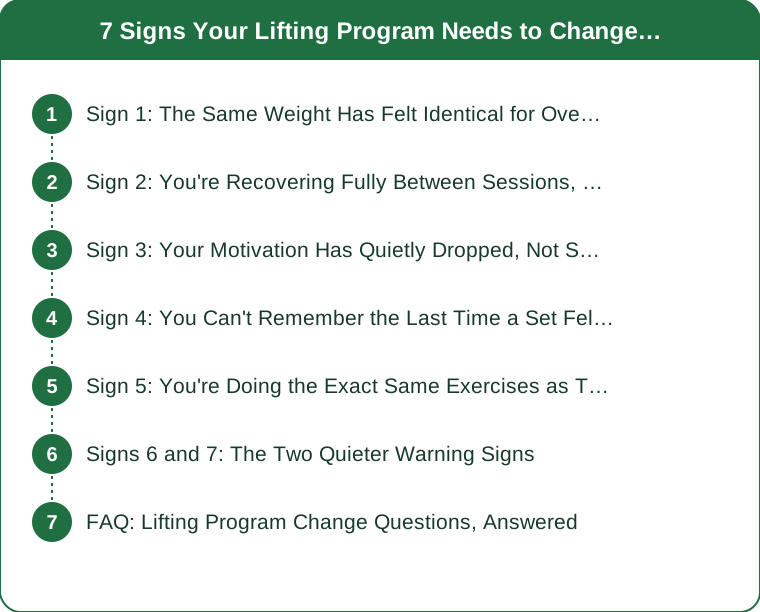
Sign 1: The Same Weight Has Felt Identical for Over a Month
No meaningful increase in weight, reps, or perceived difficulty over 4-6 straight weeks is the clearest sign your current program has run its course for producing new adaptation, regardless of how consistently you’re showing up.
Sign 2: You’re Recovering Fully Between Sessions, Every Time
Feeling completely fresh before every single session, with zero residual fatigue, often means the training stimulus is no longer enough to force meaningful adaptation — some accumulated fatigue between sessions is a normal part of a progressing program.
Sign 3: Your Motivation Has Quietly Dropped, Not Spiked
A gradual dip in motivation to train, distinct from occasional low-energy days, frequently tracks with a program that’s become monotonous rather than a personal willpower problem — variety itself is a legitimate training lever.

Sign 4: You Can’t Remember the Last Time a Set Felt Genuinely Hard
If your working sets consistently leave 4+ reps in reserve without any deliberate deload reason, the intensity has likely drifted too low to keep driving progress, even if the workouts still feel busy.
Sign 5: You’re Doing the Exact Same Exercises as Three Months Ago
Extended stretches without exercise rotation can lead to accommodation, where your body adapts so fully to specific movement patterns that they stop providing a strong enough novel stimulus.
Signs 6 and 7: The Two Quieter Warning Signs
Sign 6: Your Warm-Up Sets Feel Harder Than They Used To
If sets that used to feel like an easy warm-up now feel notably effortful at the same weight, that’s often an early sign of accumulated fatigue outpacing your current recovery capacity, worth addressing with a deload before it becomes a bigger issue.
Sign 7: You’re Tracking Nothing and Guessing Everything
Without logged numbers, it’s nearly impossible to notice a plateau early — many lifters don’t realize they’ve stalled for months simply because there’s no record to compare against.
FAQ: Lifting Program Change Questions, Answered
How big of a change does a stalled program actually need?
Often a smaller adjustment — new rep ranges, added exercise variation, or a deload week — resolves a plateau without requiring a completely new program.
Could poor sleep or nutrition explain these signs instead of the program itself?
Yes — it’s worth ruling out recovery basics first, since a great program still stalls without adequate sleep and food to support adaptation.
How often should a lifting program change under normal circumstances?
Every 8-12 weeks is a common guideline, though the actual signal should come from performance data, not a fixed calendar.
TL;DR:
- A stalled lift for 4-6 weeks despite consistent effort is the clearest plateau signal
- Full recovery every session and low motivation both often point to insufficient stimulus
- Sticking with identical exercises for months risks accommodation, not just boredom
- Tracking numbers is what makes a quiet plateau visible before frustration sets in
Seven small signs, stacked together, tell the story long before the plateau feels obvious — the fix is usually smaller than it seems.
Keep Reading
This article is for general informational and styling purposes only. Fit, sizing, and product availability may vary.