7 Signs Your Program Is Too Easy (That Are Not About Weight)
Quick Answer: A programme is too easy when it stops demanding adaptation, and the weight on the bar is a poor detector of that. The seven signals: you never approach failure, sessions never feel hard, nothing has changed in 8 weeks, you never need a deload, warm-ups feel identical to work sets, you are never sore after new stimuli, and you can talk comfortably through every set. Any three of these together means it is time to add load, volume, or proximity to failure.
Work through them honestly - most people find at least two apply.

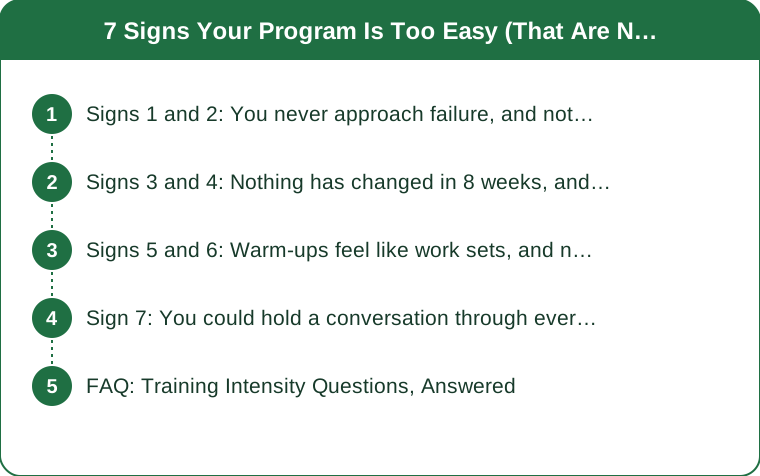
Signs 1 and 2: You never approach failure, and nothing ever feels hard
1. Every set ends because the number said so
Proximity to failure drives hypertrophy and strength. Sets taken to within roughly 1 to 3 reps in reserve produce substantially more adaptation than sets stopped at 5+ RIR.
The common pattern: a programme says 3 sets of 10, so you do 10 and rack it - even though 15 were available. You completed the prescription and missed the stimulus.
The test: on your last set of an accessory exercise, go to genuine technical failure. If you get more than 3 extra reps beyond the prescription, the load is too light.
The fix: train the last set of each exercise to 1 to 2 RIR, and use that to calibrate the load for the following week.
2. Sessions never feel genuinely demanding
Training should be hard sometimes. Not every session, but a programme where nothing ever feels difficult is a programme that is maintaining rather than building.
Leaving the gym exactly as you arrived, every session, for months is the clearest single signal available.
The distinction that matters: hard means the last two reps of a set require real intent, not that you are exhausted and shaking. You want difficulty, not destruction.
Signs 3 and 4: Nothing has changed in 8 weeks, and you never need a deload
3. Your numbers, measurements, and photos are identical to two months ago
Eight weeks of consistent training should produce measurable change in a novice or intermediate lifter - more weight, more reps at the same weight, or visible change.
Check all three: working weights, reps at a fixed load, and photos in the same light and position. Plateau across all three for 8 weeks is diagnostic, not bad luck.
The most common cause is not a bad programme. It is the same weights for the same reps every week - training that has quietly become maintenance while feeling like progress because it is consistent.
The fix is progressive overload made explicit: add 2.5kg to lower-body lifts or 1 to 2kg to upper-body lifts weekly, or add a rep per set, or add a set. Write down what changes each week before the session, not after.
4. You never accumulate enough fatigue to need a deload
Properly loaded training accumulates fatigue over a 4 to 8 week block, which is what a deload exists to clear.
If you have trained for six months and never felt you needed one, you have almost certainly never approached the loading that requires it.
This is not an argument for training yourself into the ground. It is a diagnostic: the absence of any accumulated fatigue means the absence of a meaningful stimulus.

Signs 5 and 6: Warm-ups feel like work sets, and new exercises never make you sore
5. There is no perceptible gap between your warm-up and your working weight
A working set should feel qualitatively different from a warm-up. If your 60kg warm-up and your 70kg work set feel essentially the same, the work set is a warm-up with a different label.
A reasonable structure: warm-up sets at roughly 40%, 60%, and 80% of your working weight, then the working sets. You should notice the change at the last step.
The fix: increase the working load until there is a clear difference, then rebuild the warm-up ramp underneath it.
6. A brand-new exercise never produces any soreness
Novel movements produce soreness even in trained lifters - the repeated bout effect protects you against exercises you already do, not against new ones.
Adding a new exercise and feeling nothing at all usually means the load was far too conservative.
Caveat: soreness is not the goal and it is a poor measure of a session’s value in general. But total absence of soreness from a genuinely novel stimulus is informative, and it is one of the few times soreness tells you something useful.
The fix: for new exercises, spend one session finding a genuinely challenging load rather than starting at the lightest available option and staying there for a month.
Sign 7: You could hold a conversation through every set
The simplest test on the list, and the one most people fail.
A set at 1 to 3 RIR does not allow comfortable conversation. Breathing changes, attention narrows, and speaking becomes an effort. If you can chat easily through your last set of squats, that set is not doing what you think it is.
This applies less to accessory and pump work, where lighter loads are appropriate. On compound lifts it is a reliable signal.
The related tell is your rest periods. If you never need more than 60 seconds between heavy compound sets, the sets are not demanding enough - genuine work at 1 to 3 RIR on a compound lift requires 2 to 3 minutes to repeat at quality.
What to change, in order of priority:
- Proximity to failure - take the last set of each exercise to 1 to 2 RIR. Free, immediate, and the largest single lever.
- Load - add small increments weekly rather than waiting to feel ready.
- Volume - add a set per exercise, up to a sensible weekly total per muscle group.
- Frequency - move from one to two sessions per muscle group per week.
Change one variable at a time and give it 3 to 4 weeks. Changing everything at once means you learn nothing and often accumulate fatigue faster than you can recover from it.
One caution: if you are returning from injury, sleeping badly, or in a significant calorie deficit, an easier programme may be entirely appropriate. Under-training is a problem in the context of good recovery - the same programme can be correct in one season of life and too easy in another.
This is general training information, not medical advice.
FAQ: Training Intensity Questions, Answered
How close to failure should I train?
For most sets, 1 to 3 reps in reserve. Occasional sets to genuine failure on isolation work are useful for calibration but do not need to be the default.
How do I know if I am progressing?
Track working weights, reps at a fixed load, and photos under consistent conditions. Any one of those improving over 8 weeks is progress; none of them improving is a plateau.
Should every session feel hard?
No. A well-designed week has harder and easier sessions. But if no session in a month felt genuinely demanding, the programme is maintaining rather than building.
How often should I deload?
Every 4 to 8 weeks, depending on training age and how hard the block has been. If you never feel you need one, that is a signal about the loading rather than about your resilience.
What if I add load and my form breaks down?
Then the load is too heavy for now, and the answer is to add reps or sets at the current weight instead. Progressive overload does not have to mean more weight every week.
TL;DR:
- The seven signals: never approaching failure, nothing ever feels hard, no change in 8 weeks, never needing a deload, warm-ups indistinguishable from work sets, no soreness from new exercises, and comfortable conversation through every set.
- Proximity to failure (1 to 3 RIR) is the biggest free lever - most people leave 5+ reps in reserve without realising it.
- Progress by explicitly changing one variable a week and writing it down before the session.
- Change one thing at a time and give it 3 to 4 weeks - and remember that an easy programme is correct during injury, poor sleep, or a deep deficit.
The reason this matters is that under-training is far more common than over-training and considerably harder to spot, because it feels exactly like being consistent. Consistency without progression is just maintenance with a training log attached.
Keep Reading
This article is for general informational and styling purposes only. Fit, sizing, and product availability may vary.