7 Signs Your Workout Split Is the Problem, Not Your Effort
Quick Answer: The most common structural problems are training each muscle only once a week, stacking too many exercises per session, putting your priority lifts at the end, and having a split that does not match how many days you actually train. Effort is usually not the limiting factor for people who feel stuck - organization is. Seven signs, and each has a specific fix.
If you are working hard and progressing slowly, look at the shape of the week before you add more.

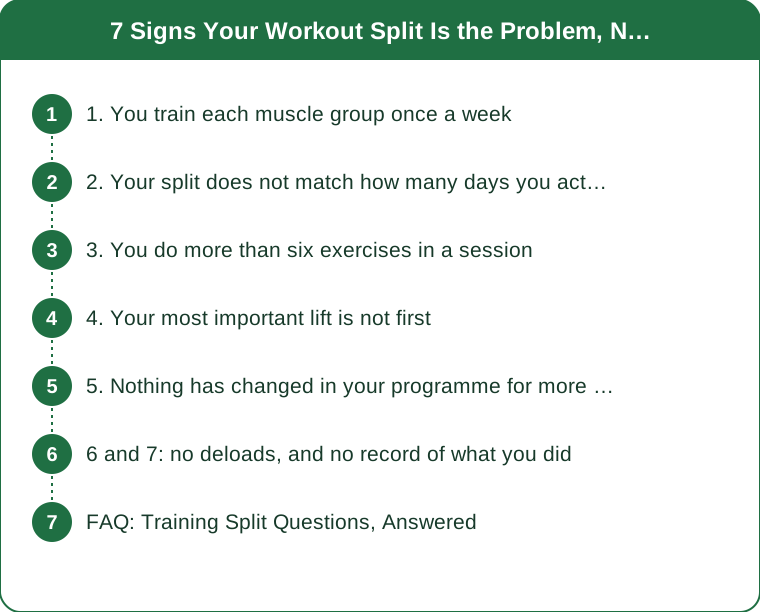
1. You train each muscle group once a week
This is the single most common structural problem, and it is a holdover from bodybuilding magazines aimed at people whose recovery was not entirely natural.
Muscle protein synthesis - the process by which a muscle actually adapts to training - is elevated for roughly 24 to 48 hours after a session, and then returns to baseline. Training a muscle on Monday and again the following Monday means five days a week where nothing is being stimulated.
Research on training frequency fairly consistently finds that training a muscle twice a week produces better results than once, when total weekly volume is matched. It is not that more is better - it is that the same amount of work, split across two sessions, produces two adaptive windows instead of one.
The fix: move to an upper/lower split run four days a week, or a full body split run three days. Both hit everything twice or more. If you are attached to a body-part split, at least pair the smaller groups so nothing waits seven days.
One exception worth noting: advanced lifters using very high volume per session may do fine with lower frequency, because their per-session volume is high enough to extend the adaptive window. That is not most people, and it is not you if you are stalled.
2. Your split does not match how many days you actually train
People choose a five-day split and then train three times a week. The result is not a five-day split at reduced volume - it is chaos.
What happens is that sessions get skipped in whichever order the week allows, so leg day gets missed twice a month while chest gets trained every week. Over three months this produces meaningfully uneven development and a set of stalled lifts that have no obvious cause.
The honest question is not how many days you would like to train. It is how many days you trained in each of the last four weeks. Take the lower number.
The fix, by real training frequency:
- 2 days a week: full body, both sessions. Everything gets hit twice.
- 3 days: full body, or an upper/lower/full rotation
- 4 days: upper/lower, twice each. This is the sweet spot for most people.
- 5 days: upper/lower/push/pull/legs, or an upper/lower with an accessory day
- 6 days: push/pull/legs twice, which requires genuinely good recovery habits
A split built for the days you actually have will outperform a better split you only partially complete. This one change resolves more stalls than any exercise selection question.
3. You do more than six exercises in a session
Session quality falls off a cliff after a certain point, and that point is earlier than most programmes assume.
By exercise seven or eight, you are fatigued, your technique has degraded, and the load you can handle has dropped substantially. The work you do at the end of a long session is low-quality work, and low-quality work still costs recovery. You pay full price for a partial stimulus.
There is a research finding worth knowing here: the relationship between volume and results flattens out and then reverses. More sets help up to a point - roughly 10 to 20 hard sets per muscle group per week for most people - and past that, additional volume mostly adds fatigue.
The fix: four to six exercises per session. Two or three compounds, two or three accessories. If you have eight things you want to train, you need two sessions, not a longer one.
A useful test: look at the last two exercises in your session and ask whether you have progressed on either in the last two months. If not, they are costing recovery and producing nothing, and cutting them will improve everything before them.

4. Your most important lift is not first
Whatever you do first in a session gets your best effort. Everything after it is done in a progressively more fatigued state.
So if your squat has stalled and you squat after leg press, leg extensions, and lunges, the squat is not stalled - it is being performed by someone who has already done a leg workout.
The order rule: heaviest, most technical, and highest-priority movements first. Compounds before isolations. The lift you most want to improve goes first, every time, without exception.
What people do instead:
- Warming up with 20 minutes of cardio, which pre-fatigues the legs before squatting
- Doing accessories first because the rack is busy - wait for it, or reorder the whole session
- Putting the lift they enjoy first and the one they need last
- Training the same order every single session for a year, so one lift always gets the fresh slot and another never does
A fix that costs nothing: if two lifts both matter, alternate which goes first between sessions. Squat first on Monday, Romanian deadlift first on Thursday. Both get fresh weeks.
5. Nothing has changed in your programme for more than three months
Adaptation is specific and it plateaus. The same stimulus produces a smaller and smaller response over time - this is the fundamental logic of progressive overload, and it applies to exercise selection and structure as well as load.
A reasonable timeline is 8 to 12 weeks on a programme, then a change. Not a total rebuild - changing everything at once means you lose track of what was working - but a meaningful adjustment: swap accessory movements, change the rep range, adjust the split, or alter the order.
The opposite error is just as common. Programme hopping - changing every three weeks because progress is not visible - never gives anything long enough to work. Strength adaptations take six to eight weeks to show clearly. If you have not run something for eight weeks, you do not know whether it works.
The signal to change: three to four weeks with no progression in load, reps, or quality on your main lifts, when sleep and food are reasonable. That is a genuine plateau. Two bad sessions is not.
What to change first, in order: rep range, then accessory selection, then split structure. Change one thing at a time so you can tell what did it.
6 and 7: no deloads, and no record of what you did
6. You have never taken a deload
Fatigue accumulates across weeks, and it accumulates faster than most people notice because it shows up as slightly heavier warm-ups and slightly worse sleep rather than as anything dramatic.
A deload is one week in every four to eight where volume drops by roughly half, or intensity drops to about 70 percent of your usual loads. It feels unnecessary and unproductive. Then week one of the next block, everything moves better.
Signs you are overdue: warm-up weights feel heavy, motivation has dropped, sleep is worse, small joints ache, and your numbers have been flat for a month. That combination is accumulated fatigue, not weakness, and adding intensity to it makes it worse.
Deloading proactively beats deloading when forced. The forced version is usually called an injury.
7. You are not logging anything
Without a record, you cannot see progression, which means you cannot apply progressive overload - you are guessing at loads based on how you feel that day.
What to log: exercise, weight, sets, reps, and a note on how it felt. That is enough. A notebook works as well as any app.
What it makes possible: knowing that you did 8 reps at a given weight last week so you should attempt 9 this week. Noticing that a lift has been flat for a month. Spotting that every session you rate as bad follows a night of poor sleep.
Most people who feel stuck are actually progressing slowly and cannot see it, and that misreading is what drives the unnecessary programme changes. A log turns a vague sense of stagnation into a specific number you can act on.
A note on when it is not the programme: if sleep is under six hours, food is inadequate, or life stress is high, no split will rescue that. Those are the actual limiting factors and they outrank every structural question here. This is general information, not medical advice.
FAQ: Training Split Questions, Answered
What is the best split for a beginner?
Full body, three days a week. It gives high frequency per muscle, plenty of practice on the main movements, and it is forgiving if you miss a day. Most people should stay on it for at least six months.
How do I know if I am doing enough volume?
Roughly 10 to 20 hard sets per muscle group per week is the range most evidence points to. Below 10 is often too little for progress; above 20 usually adds fatigue faster than results.
Can I train the same muscle two days in a row?
Yes, if intensity is managed - heavy one day, lighter and technical the next. Two hard sessions back to back for the same muscle usually means the second one is done in a compromised state.
How long should a session be?
45 to 75 minutes of actual training. Beyond that, quality falls and the marginal work rarely justifies the recovery cost. If your sessions run past 90 minutes, look at rest periods and exercise count.
Should women train differently from men?
The structural principles are identical - frequency, volume, progression, and recovery all work the same way. Individual differences in recovery, preference, and cycle-related energy fluctuations matter more than sex-based programme differences do.
TL;DR:
- Training a muscle once a week wastes five days of the adaptive window. Twice weekly is better at matched volume.
- Pick a split that matches the days you actually trained last month, not the days you hope to.
- Four to six exercises per session. The last two of a long session cost recovery and produce little.
- Your priority lift goes first, every time. Alternate which lift gets the fresh slot if two matter.
- Change something every 8 to 12 weeks, deload every 4 to 8, and log everything.
Most stalls are structural. Check the shape of your week before you add intensity to it.
Keep Reading
This article is for general informational and styling purposes only. Fit, sizing, and product availability may vary.