7 Signs You're Actually Ready to Increase Your Weights (Not Just Bored)
Quick Answer: The clearest signs you’re ready to increase weight are hitting your top rep target with 1-2 reps in reserve for 2+ consecutive sessions, clean form through every rep, and full recovery by your next session — feeling bored or impatient with a weight isn’t on that list and shouldn’t drive the decision alone.
Wanting to lift heavier and being ready to lift heavier are two different things — here’s how to tell which one you’re actually feeling.

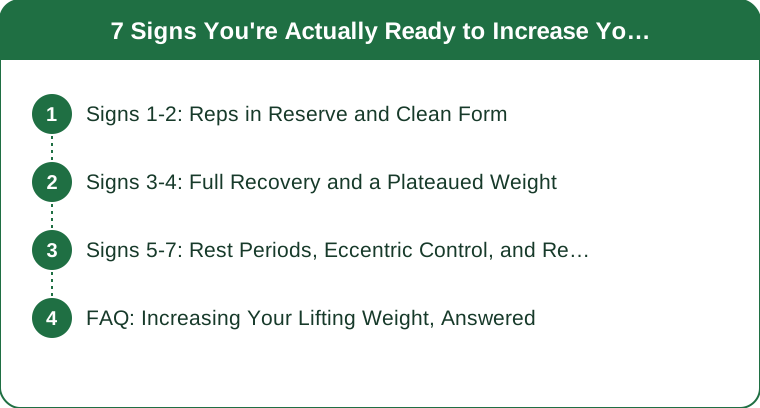
Signs 1-2: Reps in Reserve and Clean Form
Sign 1: You’ve hit your top rep target with reps to spare
If your program calls for 3 sets of 10 and you’re completing all 3 sets of 10 with 1-2 reps left in the tank (RIR) for two sessions in a row, the current weight is no longer providing enough stimulus.
Sign 2: Your form stays clean through the last rep
Weight should only increase once technique holds up through the hardest rep of the hardest set, not just the easy early reps. Breaking form on rep 8 of 10 is a sign the current weight is still appropriately challenging, not a green light to add more.
Signs 3-4: Full Recovery and a Plateaued Weight
Sign 3: You’re recovering fully before the next session
Lingering soreness or fatigue heading into your next scheduled session for that muscle group suggests the current load is already providing plenty of stimulus — adding more before recovery catches up compounds fatigue rather than building strength.
Sign 4: The weight has felt the same for 2-3 sessions straight
Consistent, unchanging effort across several sessions at the same weight — not gradually feeling harder or easier — is a stable signal you’ve adapted and it’s time for a new stimulus.

Signs 5-7: Rest Periods, Eccentric Control, and Real Readiness vs Boredom
Sign 5: Your rest periods aren’t creeping up
If you’re needing longer rest between sets just to complete the same reps at the same weight, that’s more often a fatigue or recovery issue than a readiness signal — address that before adding load.
Sign 6: You can control the eccentric (lowering) phase
Being able to lower the weight with control, not just muscle through the concentric lift, is a marker of real strength adaptation — an uncontrolled eccentric is a sign the current weight, or your fatigue level, isn’t fully mastered yet.
Sign 7: It’s not just gym boredom talking
Restlessness with a weight that still challenges you on the hardest rep isn’t a readiness signal — it’s motivation, which is valuable but separate from actual physical readiness. Use signs 1-6 as the real gate, not impatience.
FAQ: Increasing Your Lifting Weight, Answered
How much weight should I add once I’m ready?
A common guideline is roughly 2.5-5% of your current working weight for upper body, 5-10% for lower body — small enough to maintain form, big enough to matter.
What if I’m ready by some signs but not others?
Progress on the specific dimension that’s ready (add a rep instead of weight, for example) rather than forcing a full weight jump when only some signs are met.
Is it bad to stay at the same weight longer than necessary?
Some plateau time is normal and not harmful, but repeatedly hitting all 7 signs without progressing does slow long-term strength gains unnecessarily.
TL;DR:
- Hitting top reps with 1-2 in reserve for 2+ sessions is the clearest readiness signal
- Clean form through the hardest rep matters more than completing the set at all
- Full recovery before your next session means the current load isn’t maxing you out
- Boredom or impatience with a weight isn’t a readiness signal on its own
Add weight when the signs say ready, not when the mirror or your mood says impatient.
Keep Reading
This article is for general informational and styling purposes only. Fit, sizing, and product availability may vary.