8 Signs Your Grip Is the Real Limit on Your Lifts
Quick Answer: Grip is the most common silent limiter in lifting, because it fails in ways that look like something else - a rounded back, a rep that slows near lockout, a set you stopped one short of. If your last rep ends with the bar rolling out of your fingers rather than with your legs or back giving up, grip is your ceiling.
The good news: grip responds fast, often within four to six weeks, and the fixes are simple.
Here are eight signs, in rough order of how often they turn out to be the answer.

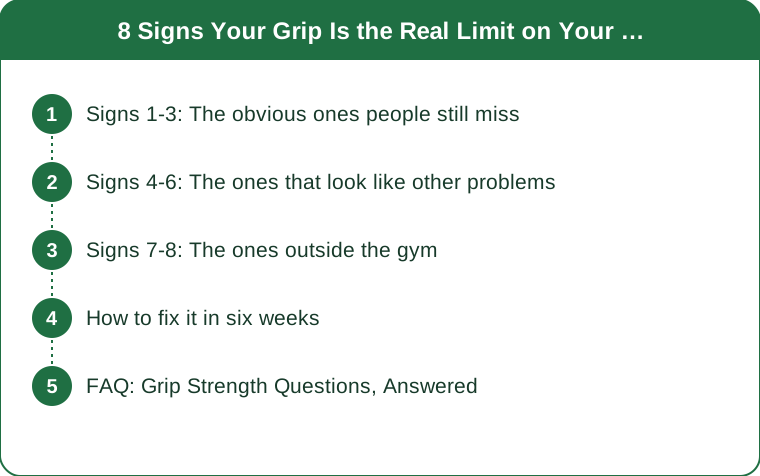
Signs 1-3: The obvious ones people still miss
1. The bar starts rolling toward your fingertips mid-set
This is the clearest signal there is and people normalise it. A secure grip keeps the bar at the base of the fingers. When it migrates toward the fingertips, the finger flexors are losing and you are now hanging on rather than holding on.
The tell that confirms it: you find yourself regripping between reps, which is grip failure announcing itself politely before it announces itself rudely.
2. Your last rep fails at the hands, not the muscles
You finish a set and your forearms are screaming while your back and legs feel like they had more in them. That is not a hard set for your posterior chain - that is a set your grip ended early.
The diagnostic: repeat the same set with straps. If you get three more reps easily, grip was the limit and you have been undertraining the target muscle for however long this has been happening.
3. Your form breaks down in the hands first
Shoulders shrug up, elbows bend slightly, the bar drifts forward. These read as technique errors and are frequently grip compensations - the body shortening the lever to help the hands hold on. Fix the grip and the technique problem often disappears without ever being coached.
Signs 4-6: The ones that look like other problems
4. You can hold much less than you can lift
A rough working benchmark: you should be able to hold your deadlift weight for 20 to 30 seconds. If you can pull 100kg but cannot hold it for 15 seconds, your grip is limiting a lift it can barely support statically.
Test it directly - deadlift to standing, then hold and count. Most people are surprised and slightly annoyed by the result.
5. Your left and right hands fail at different times
One hand always goes first, and it is usually the non-dominant one. This shows up as the bar tilting slightly at the top of a heavy pull, or as one shoulder shrugging more than the other.
Asymmetric grip does more than limit the lift - it puts uneven load through the spine on every rep, which is a slow problem rather than an acute one. Single-arm carries fix this faster than anything else.
6. Pulling exercises never feel like they hit the target muscle
Rows and pulldowns that you feel in your forearms rather than your lats are a common presentation. The forearms fatigue first, so you finish the set before the lats have been meaningfully challenged.
This is why people plateau on back development and blame the exercise selection. The exercise was fine; the set ended for the wrong reason.

Signs 7-8: The ones outside the gym
7. Everyday tasks feel harder than your lifting numbers suggest
Jars, heavy shopping bags, holding a suitcase, opening a stiff door. If you deadlift respectably and struggle with a carrier bag from the car to the front door, there is a genuine mismatch between your pulling strength and your holding strength.
This matters beyond the gym. Grip strength is one of the more robust markers in longevity and healthy-ageing research - it correlates with a range of outcomes well enough to be used as a clinical measure. That is a reason to train it independent of your deadlift.
8. You have started using straps for everything
Straps are a legitimate tool and the way most people use them guarantees the problem never resolves. Strapping every set from the first warm-up means the grip never gets trained at all, and the gap widens month after month.
The workable rule: no straps below roughly 85 percent of your working weight, and never on rows or carries. Strap the top sets of heavy deadlifts if you need to - that is what they are for - and let everything else build your hands.
And a note on what grip failure actually is: it is usually endurance rather than maximum force. You can hold the bar for the first three reps and not the sixth, which points to holding capacity rather than crushing capacity - and those train differently.
How to fix it in six weeks
Grip responds quickly, and the fixes fit into sessions you are already doing.
Add these three things:
- Farmer’s carries. The single most effective grip builder - two heavy dumbbells or kettlebells, walk 30 to 40 metres, three sets, twice weekly. It also builds trunk stability and shoulder health for free
- Dead hangs. Hang from a bar for maximum time, three sets, after your pulling work. Start where you are, even if that is 15 seconds, and expect to double it within a month
- Timed holds at the top of your deadlift. After your last working set, hold the bar for 20 seconds. Costs nothing, takes 20 seconds, and directly trains the exact quality you need
The habits that matter more than the exercises:
- Use chalk. A large proportion of perceived grip weakness is sweat, not strength. Chalk is the cheapest strength gain available
- Hook grip or mixed grip for heavy pulls. Hook grip is genuinely uncomfortable for the first two weeks and then simply works. Mixed grip is easier and creates an asymmetry, so alternate which hand is over
- Grip the bar as hard as you can on every set, including warm-ups. Deliberate maximal gripping is itself training
- Train the weaker hand with one extra set on single-arm work
Expect noticeable change in four to six weeks, and expect the first improvement to show up as fewer regrips rather than as a bigger number. If you get numbness, tingling, or pain in the hand rather than fatigue, that is a different signal and worth having looked at rather than training through. This is general information, not medical advice.
FAQ: Grip Strength Questions, Answered
Are grip trainers - the squeeze kind - useful?
Moderately, and they train crushing grip while lifting mostly needs supporting grip. Carries and hangs transfer far better to the barbell, so use the squeezers as a supplement rather than as the plan.
Should I use straps at all?
Yes, for top-end heavy pulls where grip would otherwise cap the training stimulus for your back and legs. The failure mode is using them everywhere from warm-up onward, which guarantees the grip never catches up.
Why does my grip feel weaker some days?
Sleep, hydration, and recent forearm work all show up here quickly, and grip is one of the more sensitive fatigue markers in the body. A noticeably weak grip day is often a useful early signal that you are underrecovered generally.
Do thicker bars help or just make it harder?
They build grip effectively, and they also reduce how much you can lift, so use them as an accessory rather than for main lifts. A pair of thick-grip attachments on carries is an efficient way to get the benefit without compromising your primary work.
TL;DR:
- If the bar rolls to your fingertips or you regrip between reps, grip is the limiter
- Test it: repeat the set with straps - three easy extra reps means grip ended the last one
- Grip failure often looks like a form breakdown or a back that will not grow
- Chalk, hook grip, and gripping hard on every warm-up set fix more than exercises do
- Add farmer’s carries, dead hangs, and 20-second top holds - expect change in 4 to 6 weeks
After your next deadlift set, hold the bar at the top and count. If you cannot reach 20 seconds, you have found your ceiling.
Keep Reading
This article is for general informational and styling purposes only. Fit, sizing, and product availability may vary.