7 Signs Your Program Is Working Even Though the Weight Has Not Moved
Quick Answer: Load is one of at least seven progress markers. Rep quality, bar speed, recovery between sets, reduced warm-up requirement, improved positions, better session-to-session consistency, and rising work capacity all indicate adaptation, and all of them typically move before load does.
Six weeks at the same weight. You are doing everything right and the number has not changed, and the natural conclusion is that nothing is happening.
That conclusion is usually wrong. Load is the loudest progress signal and one of the slowest. Here are seven quieter ones that move first.

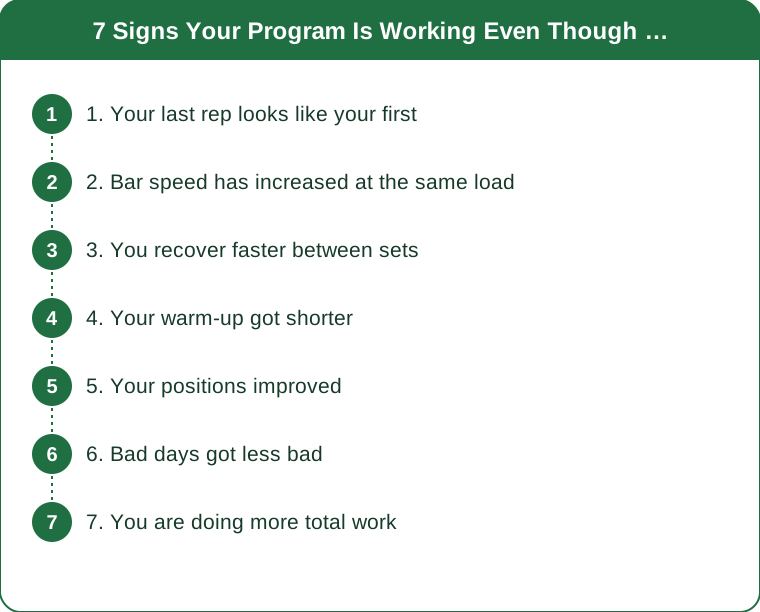
1. Your last rep looks like your first
Film a set from six weeks ago and one from today at the same weight.
If the fifth rep used to slow dramatically and grind while today it moves like the second, you have gained strength that has not yet reached the point of adding load. Rep quality across a set is one of the earliest and most reliable indicators of adaptation.
This matters practically, too: consistent rep quality means more effective reps per set, which drives further adaptation. Progress in quality precedes progress in load almost universally, and it is invisible without film.
It is also the safest signal to act on. A weight you can move with identical quality across all five reps is a weight ready to increase; a weight where rep five degrades is one to keep for another fortnight.
2. Bar speed has increased at the same load
Velocity at a fixed load is one of the most direct measures of strength change available.
If a weight that used to move slowly now moves quickly, your force production has increased even though the number on the bar has not. This is the principle behind velocity-based training, and you do not need a device to notice a large change.
The practical version: note whether a working set feels explosive or laboured, and keep the observation in your log. A weight that has gone from grinding to snappy over six weeks is a weight you are ready to move past — which is often the actual reason the plateau ends the week after someone notices this.
A simple three-point scale is enough: fast, normal, grinding. Written next to every top set, it turns a vague impression into a trend you can read at a glance.
3. You recover faster between sets
If you used to need four minutes between heavy sets and now three is comfortable, your work capacity has improved measurably.
Recovery between sets depends on phosphocreatine resynthesis and on cardiovascular and metabolic fitness, all of which adapt to training. Shorter recovery at the same performance is unambiguously a fitness improvement, and it compounds by letting you do more total work per session.
Time your rest for one session and compare it to your notes from a month ago. Most people are resting less than they think and have no record of it, which is exactly why this progress goes unnoticed.
Be careful not to turn this into a target, though. Deliberately cutting rest to prove a point reduces performance on the following set, and the improvement you want is the kind that happens on its own.

4. Your warm-up got shorter
A warm-up that used to take four ramp-up sets and now takes two is telling you something real.
Warm-up requirement reflects neural readiness and how well you have grooved the movement pattern. A well-practised movement needs less preparation to reach full output, because the coordination is more automatic and the tissue is more accustomed to the load.
This shows up especially clearly in technically demanding lifts. If your first working set now feels ready in a way it did not two months ago, that is skill acquisition — and skill is a legitimate and often overlooked component of strength.
There is a practical bonus: a shorter warm-up frees ten or fifteen minutes per session, which is often enough to add the accessory work that breaks the plateau.
5. Your positions improved
A squat that used to lose its upper back position at the bottom and now holds it is a stronger squat at the same weight.
Position is not cosmetic. Better positions mean better force transfer, less energy leaking into stabilising, and lower injury risk. A lift performed in a better position is a genuinely different and more demanding lift, even with an identical number on the bar.
This is also why adding load before positions are solid tends to stall progress rather than accelerate it. Six weeks spent making the position reliable frequently unlocks a run of load increases immediately afterwards.
Film from the side once a month. Position changes are gradual enough that you will not feel them and obvious enough that you cannot miss them on video.
6. Bad days got less bad
Track your worst session of the month rather than your best.
Most people measure progress by their peak — the day everything felt light. A more useful metric is the floor. If your bad sessions used to drop 15 percent below your normal and now drop 5 percent, your training is more robust, which usually reflects better recovery, better sleep habits, or genuinely higher capacity.
Consistency also compounds in a way peaks do not. Twelve solid sessions a month beats four great ones and eight poor ones, and a rising floor is what produces that.
Note the reason alongside a bad session too — poor sleep, a long day, a missed meal. After two months the pattern usually names the thing worth fixing, and it is rarely the programme.
7. You are doing more total work
Add up sets times reps times load across a week and compare it to two months ago.
Total volume frequently rises well before top-end load does — an extra set here, two more reps there, an accessory exercise added. Volume is a primary driver of hypertrophy and a substantial contributor to strength, and it accumulates so gradually that nobody notices it happening.
This is the single best argument for keeping a written log. Without one, six weeks of steady progress genuinely does look like six weeks of the same weight, and people quit perfectly good programmes on the strength of that impression.
Volume also creeps downward just as invisibly. A dropped accessory here, a fourth set quietly becoming three, and a month later the weekly total is lower than it was while the sessions still feel just as hard.
If none of these seven has moved in eight weeks, then something probably does need changing — usually recovery, nutrition or programme structure rather than effort. Check sleep and protein intake first, since both are far more common limiters than programme design, and both are easier to fix. But check all seven markers before concluding anything.
TL;DR:
- Load is the slowest progress marker, and at least six others move before it.
- Rep quality, bar speed and shorter rest are early, measurable signs of real adaptation.
- Better positions and shorter warm-ups reflect skill and neural change that load increases follow.
- Track your worst session and your weekly total volume — both usually improve invisibly.
Pick two of these to record for the next month. A log that only contains weight and reps is throwing away most of the evidence that your training is working.
Keep Reading
This article is for general informational and styling purposes only. Fit, sizing, and product availability may vary.