Do You Actually Need to Train to Failure to Build Muscle?
Quick Answer: Research suggests training close to failure (leaving 1-3 reps in reserve) produces similar muscle growth to training all the way to failure, while carrying meaningfully less fatigue and injury risk — meaning failure training isn’t required for good results, though it may offer a small additional edge for more advanced lifters chasing marginal gains.
Grinding every set to complete muscular failure feels like it should be the more serious approach. The evidence says it’s mostly just the more exhausting one.

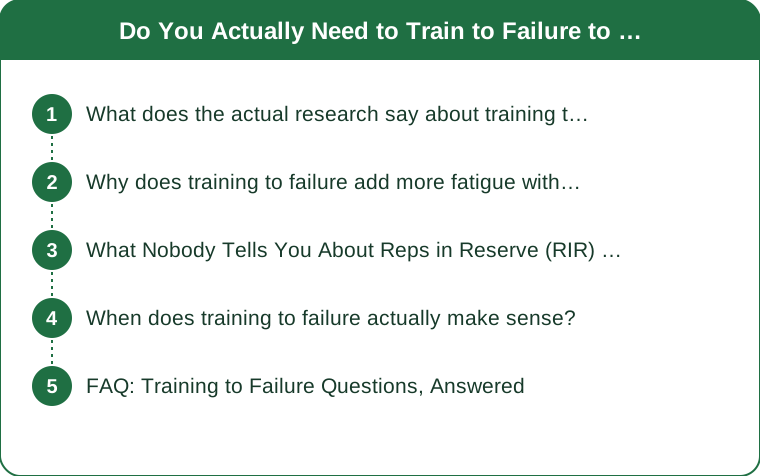
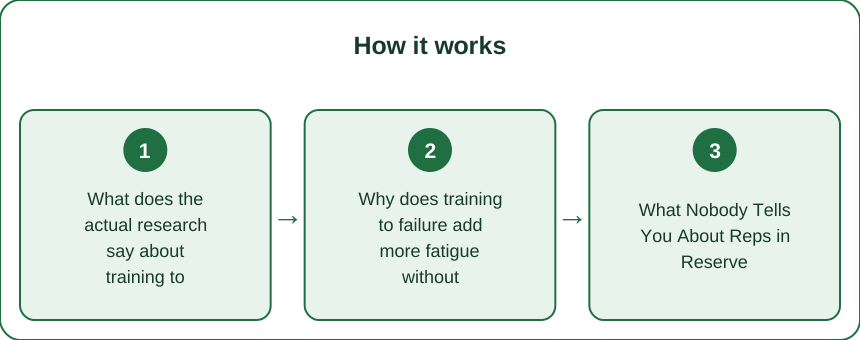
What does the actual research say about training to failure versus stopping short?
Multiple studies comparing sets taken to failure against sets stopped 1-3 reps before failure (matched for total volume) have found similar muscle growth outcomes between the two approaches, particularly for compound and moderate-to-higher rep range training.
This challenges the common assumption that failure is a necessary threshold for a set to ‘count’ toward meaningful growth — much of the benefit appears to come from moderate volume and consistent progressive overload rather than pushing every single set to its absolute limit.
Why does training to failure add more fatigue without proportional extra benefit?
The last few reps before true failure disproportionately increase central nervous system fatigue and recovery demand compared to the muscle-building stimulus they add — meaning the ‘cost’ of those final reps in terms of recovery time is high relative to their contribution to growth.
This extra fatigue can also reduce performance in subsequent sets or sessions, potentially lowering total effective weekly volume even though any single set felt more intense.

What Nobody Tells You About Reps in Reserve (RIR) Tracking
Here’s a practical detail many lifters skip: using a simple ‘reps in reserve’ (RIR) scale — estimating how many more reps you could do — is a far more useful training tool than binary ‘failure or not’ thinking, since it lets you calibrate intensity precisely across a whole program rather than treating every set the same way.
Most well-designed programs deliberately vary RIR targets across the week (some sets closer to failure, some further from it) rather than either always going to failure or always stopping conservatively.
When does training to failure actually make sense?
- Isolation exercises with lower injury risk (like leg extensions or bicep curls), where pushing closer to or to failure carries less systemic fatigue cost than a heavy compound lift
- The final set of an exercise, rather than every set, to cap off a session without accumulating excess fatigue across all working sets
- Advanced lifters seeking marginal gains who have already optimized volume and consistency, where failure training may offer a genuine small edge
- Occasionally, not as a permanent default, to periodically test genuine intensity capacity
FAQ: Training to Failure Questions, Answered
Is it bad to never train to failure at all?
No — research suggests good results are achievable while consistently leaving 1-3 reps in reserve, so avoiding failure entirely isn’t a mistake for most lifters’ goals.
Does training to failure matter more for beginners or advanced lifters?
It matters less for beginners, who see strong gains from moderate-intensity training simply due to being new to lifting; it may offer more marginal benefit for advanced lifters who’ve plateaued on standard volume.
How do you estimate reps in reserve accurately?
It takes practice, but a simple gut-check — ‘could I do 2 more reps with good form?’ — becomes more accurate over time and is a good enough practical tool without needing precise scientific measurement.
TL;DR:
- Stopping 1-3 reps short of failure produces similar growth to training to failure for most lifters
- The last few reps before failure add disproportionate fatigue relative to their growth benefit
- Tracking reps in reserve (RIR) is a more useful daily tool than an all-or-nothing failure approach
- Failure training has its place mainly on isolation moves, final sets, or for advanced lifters chasing marginal gains
You don’t need to grind every set into the ground — leaving a couple reps in the tank usually gets you nearly the same result with meaningfully less recovery cost.
Keep Reading
This article is for general informational and styling purposes only. Fit, sizing, and product availability may vary.