Why Your Grip Gives Out Before Your Back on Deadlifts
Quick Answer: Grip fails first on deadlifts because the muscles holding the bar - forearm flexors moving small finger joints - are a fraction of the size of the glutes, hamstrings, and back doing the lifting, and every set trains the big muscles harder than the small ones, widening the gap weekly. It is the expected bottleneck, not a flaw. Close it from both ends: technique that stops leaking grip strength - bar in the fingers not the palm, chalk, no re-gripping mid-set - plus two short weekly doses of direct grip work, with straps used deliberately so back training never gets capped by hand endurance.
The last rep did not fail because your hips gave up. It failed because the bar slowly unrolled your fingers and left. Different problem, different fix.

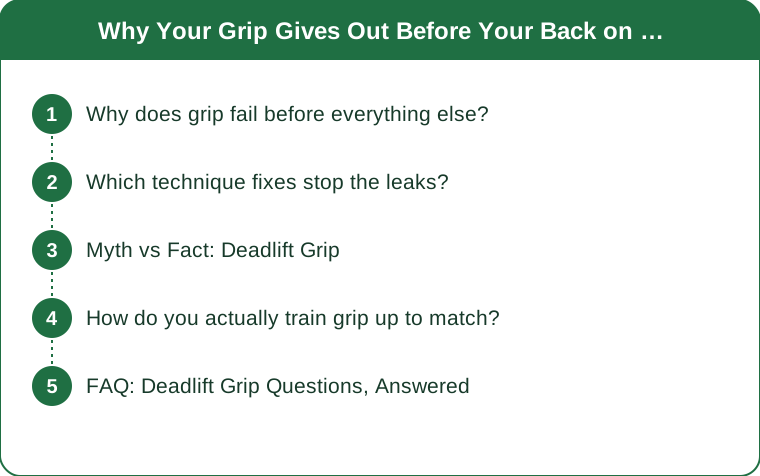
Why does grip fail before everything else?
The mismatch is built into the exercise, and understanding it stops the frustration.
The size gap is enormous. A deadlift is driven by the largest muscle groups you own - glutes, hamstrings, spinal erectors, lats. It is held by forearm flexors that would fit in your pocket. The engine outscales the coupling by an order of magnitude.
Grip works isometrically the whole set. The prime movers contract and relax rhythmically; the hands hold continuously from first pull to final lockout. Isometric endurance under maximal load is its own quality - and long sets are grip marathons even when the hips find them comfortable.
The bar actively works against you. Gravity spins a smooth bar toward the weakest point of your fingers all set long. Sweaty August hands halve the friction; a worn-smooth gym bar halves it again. Some of your grip failure is genuinely equipment and moisture, which is why chalk feels like a strength gain.
Training widens the gap by default. Every pull trains the posterior chain near its limit while grip rides along at its own - lower - ceiling. Big muscles progress faster than small ones, so the bottleneck tightens as you get stronger. Nearly every lifter meets this wall; it is a milestone, not a defect.
And leverage varies by hand. Smaller hands wrap less of the bar, giving the same weight a worse lever against the fingers. It means the standard fixes - technique, chalk, hook grip, straps - matter sooner, not that heavy pulling is off the table.
Which technique fixes stop the leaks?
Before adding strength, stop wasting the strength you have. Most lifters give away 10 to 20 percent through fixable leaks.
Put the bar in your fingers, not your palm. A bar held high in the palm folds loose skin under it and starts a slow roll downward all set. Set the bar along the base of the fingers - the crease where fingers meet palm - then wrap. It feels lower and less secure for exactly one session; it is measurably stronger.
Squeeze before you pull. Crush the bar deliberately during setup, before the legs drive. A grip established under tension holds; a casual grip asked to tighten mid-rep never fully catches up.
Chalk is not optional past warm-ups. Sweat destroys friction, and friction is half of grip. Chalk - block or liquid - is the single cheapest strength gain in the gym. If your gym bans loose chalk, liquid chalk is silent and residue-free.
Never re-grip mid-set. Adjusting your hold between reps means every rep starts from a fresh, unset grip. Set it once, keep it. If you cannot survive five reps without adjusting, the bar started in the wrong place.
Keep the arms long and quiet. Bent elbows and shrugging shoulders during the pull add movement at the hands that shears the grip. The arms are chains, not muscles, on a deadlift.
And mind the small comforts that keep sets honest - hair actually tied back, high-waisted leggings that do not need a mid-set tug: trivial-sounding, but every adjustment between reps is a re-grip in disguise, and the bar path brushing your thighs is exactly where fussing with a waistband costs you.

Myth vs Fact: Deadlift Grip
Myth: Using straps means you are weak. Fact: Straps are a tool for making back training un-cappable by hand endurance. The sensible pattern: double overhand as long as possible, then straps for the heavy back-off volume. Grip still gets trained; back never gets shortchanged.
Myth: Mixed grip is the grown-up solution. Fact: Mixed grip - one palm forward, one back - holds more weight immediately, but loads the body asymmetrically and puts the underhand biceps at tear risk when yanked. If you use it, alternate which hand supinates and keep the underhand elbow dead straight. It is a tool, not a graduation.
Myth: Hook grip is only for Olympic lifters. Fact: Hook grip - thumb trapped under the first two fingers - is brutally secure, symmetric, and increasingly standard among strength lifters. It hurts for two or three weeks and then mostly stops. For long-term heavy pulling with symmetry, it is arguably the best answer available.
Myth: Grip work will interfere with everything else. Fact: Two ten-minute doses a week - timed holds and carries - is plenty, recovers fast, and fits at the end of any session. The interference risk runs the other way: heavy grip work the day before pulling can soften your hold.
Myth: Forearm size equals grip strength. Fact: Related but far from identical - grip is substantially neural and tendinous. Small-forearmed lifters routinely out-hold bigger peers because they trained the specific quality: holding heavy things a long time.
Myth: If grip limits the set, that set still trained your back fully. Fact: A set ended by fingers ends before the posterior chain reached meaningful fatigue. Chronically grip-capped training quietly undertrains everything behind it - the exact problem straps exist to solve.
How do you actually train grip up to match?
Two short weekly doses, progressed like any lift. Expect the gap to close noticeably in six to eight weeks.
Dose one: timed holds. After a pulling session, load a bar to 60 to 70 percent of your deadlift and simply hold it at lockout - double overhand, chalk allowed - for max time. Three holds, two minutes rest between. Progress by seconds, then load. This trains the exact quality that fails: continuous crush under a real bar.
Dose two: carries. Farmer carries with heavy dumbbells - 20 to 40 metres, three or four trips - on a different day. Carries add the dynamic, real-world component and quietly train the core and traps as a bonus.
Sprinkle, do not pile. Dead hangs from a pull-up bar while stretching, the last set of rows done strapless, a thick towel wrapped around a dumbbell for one hold. Frequency of small honest doses beats a monthly forearm massacre.
Sequence the week so grip is fresh for pulling. Grip work lands after deadlifts or two-plus days away from them - never the day before. Cooked hands on pulling day sabotage the very lift you are training them for.
Use straps with intent, not guilt. A clean policy: everything double overhand until it genuinely threatens the set, straps beyond that, and one top strapless single or hold per week to keep testing honest. Your grip number and your pull number both climb, on their own schedules.
And log grip like a lift - hold times, carry weights, the heaviest strapless pull. What gets logged progresses; grip has stalled for years in lifters who never wrote it down once.
FAQ: Deadlift Grip Questions, Answered
Why does my grip fail before my legs and back?
Because small forearm muscles hold continuously while huge muscles work rhythmically, and normal training strengthens the big movers faster - the gap is structural and nearly universal. Close it with technique fixes, chalk, and two weekly grip doses rather than accepting capped sets.
Should I use straps for deadlifts?
Yes, deliberately: pull double overhand as long as it holds, then strap for heavy back-off work so your posterior chain trains fully. Keep one strapless top set or timed hold weekly and your grip keeps progressing alongside.
Is mixed grip or hook grip better?
Mixed grip is instantly stronger but asymmetric and hard on the underhand biceps - alternate sides and keep that elbow straight. Hook grip hurts for a couple of weeks, then delivers symmetric near-strap security. For long-term heavy pulling, hook grip plus occasional straps is the cleaner combination.
Does chalk really make a difference?
A large one - sweat collapses bar friction, and chalk restores it. For many lifters chalk alone adds five to ten percent to what their hands hold. Liquid chalk works where loose chalk is banned.
How fast does grip strength improve?
Quickly at first: timed holds and carries twice a week typically add noticeable seconds and kilos within three or four weeks, with the deadlift gap closing meaningfully by eight. Grip responds fast to direct work precisely because most lifters have never given it any.
TL;DR:
- Grip fails first by design: tiny muscles holding continuously against huge muscles working rhythmically.
- Stop the leaks: bar in the fingers, crush before the pull, chalk always, never re-grip mid-set.
- Straps free your back training; hook grip or carefully-managed mixed grip handle max attempts.
- Train grip directly twice a week - timed bar holds and farmer carries - logged and progressed.
- Keep one strapless test weekly so both numbers climb honestly.
Your posterior chain is not the problem, and your hands are not a life sentence. Give grip six focused weeks and the bar stops leaving early.
Keep Reading
This article is for general informational and styling purposes only. Fit, sizing, and product availability may vary.