Progressive Overload: The One Principle That Makes Strength Training Actually Work
Quick Answer: Progressive overload means gradually asking your muscles to do more over time — more weight, more reps, more sets, slower tempo, or harder variations. Skip it and you’ll lift the same numbers forever with nothing to show for it. Track your lifts, progress in small increments, and never sacrifice form for a bigger number.
If strength training had exactly one non-negotiable principle, it’s progressive overload — gradually asking your muscles to do more over time. Skip it, and you’ll lift the same weights month after month and wonder why nothing’s changing, even though you’re showing up consistently.

Why Is Progressive Overload the One Principle That Actually Matters?
Your muscles only adapt to increased demand. Give them the same stimulus week after week, and they have no reason to change — they’ve already adapted to that exact load, and “more of the same” doesn’t ask anything new of them. Skip progressive overload and you get exactly what that implies: the same weights forever, and a plateau that feels mysterious but isn’t.
This isn’t an advanced-lifter concept — it applies at every level, from your first week under a barbell to years into a serious program. It’s the actual core of what makes strength training work, more than any specific exercise selection or program design choice.

What Are the Actual Ways to Apply Progressive Overload?
Adding weight is the obvious one, but it’s far from the only lever:
- Add weight — the most obvious method, and the one people default to
- Add reps — more reps at the same weight before you increase load
- Add sets — more total volume without touching the weight
- Improve form and range — better technique and a fuller range of motion is real progression, even at the same weight
- Slow the tempo — a slower tempo increases time under tension, making the same weight genuinely harder
- Reduce rest — shorter rest between sets increases density and conditioning demand
- Progress to harder variations — moving from a supported to unsupported version of a movement, for example
That last point matters especially for bodyweight training, where “add weight” isn’t always an option — reps, tempo, and exercise variation become your main levers instead.
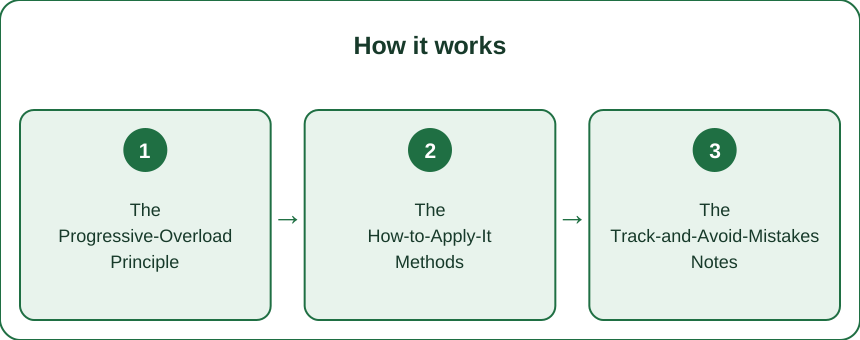
How Do You Track Progress and Avoid the Common Mistakes?
Track your lifts. You can’t progress what you don’t measure — a simple log of weight, reps, and sets each session is the difference between guessing and knowing.
Progress gradually. Small, consistent increases beat big jumps that wreck your form or your recovery. There’s no prize for adding 20 pounds in one week if it costs you three weeks of injury recovery.
Don’t sacrifice form for the number. Progress without wrecking your technique — chasing a heavier weight with sloppy form isn’t progression, it’s just risk with extra steps.
Expect it to slow down. Progress isn’t linear forever. The rate of improvement that’s normal in month one isn’t sustainable in year two, and that’s not a sign something’s wrong — it’s just how adaptation works.
Deload when needed. A planned lighter week lets your body catch up on recovery, and it often sets up your next real jump in strength.
Be patient. Real strength is built over months and years, not weeks. The strength training that compounds is the kind you stick with.
Prioritize the compounds. Progressing your big compound lifts drives more overall strength than chasing numbers on isolation work.
Myth vs Fact: Progressive Overload
Myth: “Progressive overload just means adding weight every session.” Fact: Weight is one of at least seven levers — reps, sets, tempo, rest, range of motion, and exercise difficulty all count as real progression too.
Myth: “If my numbers aren’t going up every week, I’m doing something wrong.” Fact: Progress naturally slows as you get more advanced. A beginner might progress weekly; an experienced lifter might see meaningful gains over months. Both are normal.
Myth: “Deload weeks are wasted training time.” Fact: Deloads let your body catch up on recovery and often directly set up your next strength jump — skipping them is what actually stalls progress long-term.
Mini FAQ
What exactly is progressive overload?
Gradually increasing the demand you place on your muscles over time — through more weight, reps, sets, slower tempo, less rest, or harder exercise variations.
Do I need to add weight every single session to progress?
No. You can progress through reps, sets, tempo, or form improvements just as validly as adding weight — especially useful when you’ve hit a weight plateau.
How do I know when I need a deload week?
If your lifts are stalling, your form is breaking down under normal loads, or you’re feeling unusually fatigued session after session, a deload week is usually the right call.
TL;DR:
- Progressive overload is the one non-negotiable principle in strength training
- Apply it through weight, reps, sets, tempo, rest, range of motion, or exercise difficulty
- Track your lifts — you can’t progress what you don’t measure
- Progress is not linear forever; it naturally slows as you advance
- Prioritize form over the number, and deload when your body signals it needs one
Gradually do more over time — add weight, reps, sets or tempo — track it, progress without wrecking form, and deload when needed: the progressive overload, making your strength training actually work.
Keep Reading
This article is for general informational and styling purposes only. Fit, sizing, and product availability may vary.