Progressive Overload Doesn't Only Mean Adding More Weight (Five Other Ways to Progress)
Quick Answer: Progressive overload means gradually increasing total training demand — by any legitimate variable, not just the number on the bar. When you can’t add weight, you can add sets or reps, slow the eccentric to increase time under tension, cut rest between sets, improve range of motion, or increase frequency. Each is a real overload mechanism that drives real adaptation. Rotate through them in dedicated blocks and log all of them, or your actual progress becomes invisible.
You’ve been stuck at 135 on the bench for six weeks. Same weight, same reps.
So you conclude you’ve plateaued, get frustrated, and start reading about supplements.
Meanwhile there are five other dials on the machine and you’ve been staring at one of them.

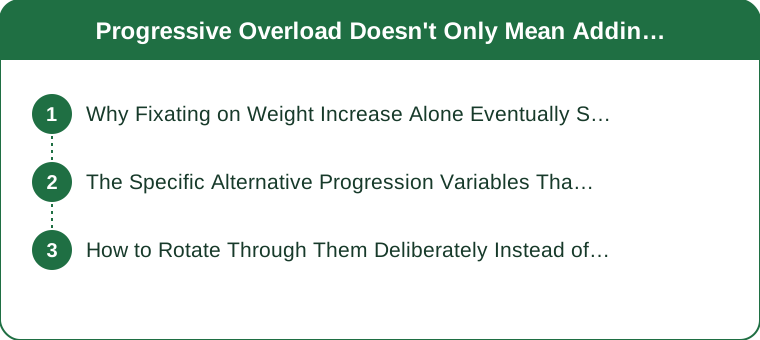
What Does Progressive Overload Actually Mean?
The principle is broader than the popular version. Progressive overload refers to gradually and systematically increasing total training demand over time — through whatever legitimate variable is available. Load is one variable. It became shorthand for the whole principle because it’s the easiest to see and the most satisfying to talk about.
And that shorthand costs you. With a weight-only definition, any stall in safely adding load — equipment limits, a joint that objects, a genuine strength plateau, a deload week — reads as a total plateau. It isn’t. It’s a plateau in one variable while several others sit completely untouched.
That distinction is the whole article. A plateau in weight is not a plateau in progressive overload, once you count what’s actually available.

What Are the Other Ways to Progress?
1. Volume — more sets or more reps at the same weight. The most straightforward alternative. Going from 3×8 to 4×8 at 135 is more total work than you did last week, which is the actual definition of increased demand. Or add reps within sets: 3×8 becomes 3×10 before you touch the load. Most weight-based programs are really rep-based programs with a load bump attached.
2. Tempo — slow the eccentric. Take three or four seconds to lower the bar instead of one. Same weight, dramatically more time under tension, and the lowering phase is where a lot of the stimulus lives anyway. A 3-second eccentric at 135 is a genuinely harder set than a 1-second eccentric at 145. Try it once and you’ll believe it.
3. Rest intervals — shorten them. Same weight, same reps, 60 seconds rest instead of 120. The metabolic and cardiovascular demand of the session goes up substantially. This is a real progression that doesn’t touch the bar at all, and it’s the one most people have never deliberately manipulated.
4. Range of motion — go deeper or fuller. A squat to parallel and a squat below parallel at the same load are different exercises. Deficit deadlifts, deeper pushups off handles, full lockout on presses. Improving range at a fixed weight is progress by any honest measure.
5. Frequency — train the movement more often. Bench twice a week instead of once, keeping per-session volume the same. Weekly total demand rises without any single session getting harder.
Myth vs Fact
Myth: These are consolation prizes for people who can’t add weight. Fact: They’re the same principle applied through different variables. Physiologically, more total work is more total work — your muscles don’t have a preference about which dial delivered it. Trained lifters spend most of their careers progressing through volume and technique because load progression slows to a crawl after the first year or two.
Myth: If the weight isn’t moving up, you’re not getting stronger. Fact: Strength gains show up as improved work capacity long before they show as a new one-rep max. Adding two reps at your working weight is getting stronger — it’s just harder to brag about.
Myth: You should progress everything at once. Fact: Fastest way to progress nothing. If you add weight, add reps, and cut rest in the same week, you’ve made the session much harder in an uncontrolled way, you’ll likely fail it, and you won’t know why.
How Do I Actually Rotate Through Them?
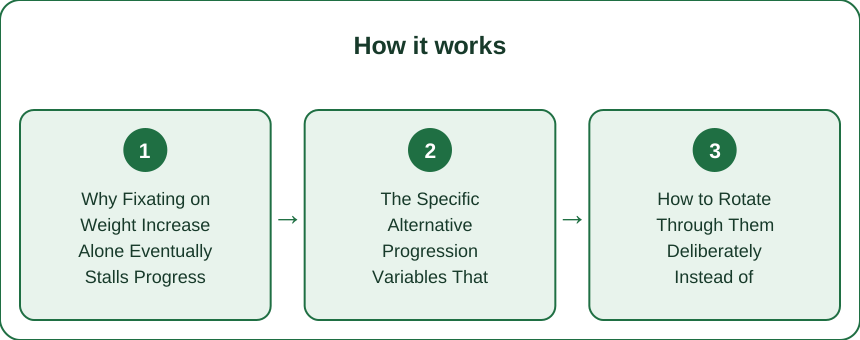
Work in blocks, one variable at a time. Four to six weeks progressing volume, then four to six weeks progressing tempo, then a block where you go back to adding load — which will now move again, because the base underneath it is bigger. Pick one variable per block, hold the others steady, and you get a clean signal about what’s working.
Reach for these deliberately when load isn’t available. A deload week, a minor injury you’re training around, a home gym where the dumbbells stop at 50 lb, a genuine strength plateau. These are the situations the alternatives were made for. Treat them as real substitutes, not as marking time until you can lift heavy again.
Log all of it, or it doesn’t exist. This is the practical failure that undoes everything above. If your training log has one column and that column is weight, then six weeks of real progress through volume and tempo will look like six weeks of nothing, and you’ll feel like you’re stalled even while you’re adapting. Log weight, sets, reps, tempo, and rest. Progress you can see is progress you’ll keep making.
Mini FAQ
How much should I progress at a time?
Small. Roughly 2–5% per week on whatever variable you’re pushing — one extra set, one or two extra reps per set, 15 fewer seconds of rest. Big jumps produce failed sessions and soreness, not faster adaptation.
Which variable should I pick first?
Volume, usually. It’s the easiest to measure, the easiest to recover from predictably, and it transfers well back into load progression when you return to it.
Can I ever go back to just adding weight?
Yes, and you should. After a volume or tempo block, load progression often restarts on its own because your work capacity has increased. That’s the point of rotating rather than abandoning.
TL;DR:
- Progressive overload = increasing total training demand, by any variable. Load is one of several.
- The alternatives: volume, tempo (slow eccentrics), shorter rest, fuller range of motion, higher frequency.
- These aren’t consolation prizes — more total work is more total work.
- Progress one variable per 4–6 week block; changing several at once tells you nothing.
- Log sets, reps, tempo, and rest — not just weight, or your real progress stays invisible.
Keep Reading
This article is for general informational and styling purposes only. Fit, sizing, and product availability may vary.